Vision
Run one company, or forty, with the same AI team.
Every company you own gets its own AI departments and its own memory; you get one bill, one audit trail and one place to read them all.
This page is for the people who own more than one company — an independent sponsor, a search fund, a lower-mid-market fund, a family holdco — and for the investors who back them. It describes where the Engine is going and, separately, what it does today.
01 — The thesis
Playbooks become software.
Every good operating partner carries a playbook: how to qualify a lead, how to answer a tender, what a proposal must contain, which contracts to send and when, what to read on Monday morning. In a portfolio the playbook is applied by hand, company by company, and it decays with every handover.
An AI back office turns the playbook into software. The same departments, the same approval gates and the same memory structure run in every company you own, and the differences between companies become data instead of folklore. The tenth company is set up like the first, and the lessons of the first are already in its memory.
The economics follow. A research desk, a bids desk, a legal desk and a marketing desk cost a salary each in one company; on the Engine they cost credits, priced per job, and the same desks are ready in the next company the day it closes. The cost of adding a company to the book stops being a hiring plan and becomes a line on one statement.
02 — Today
What exists, and what does not.
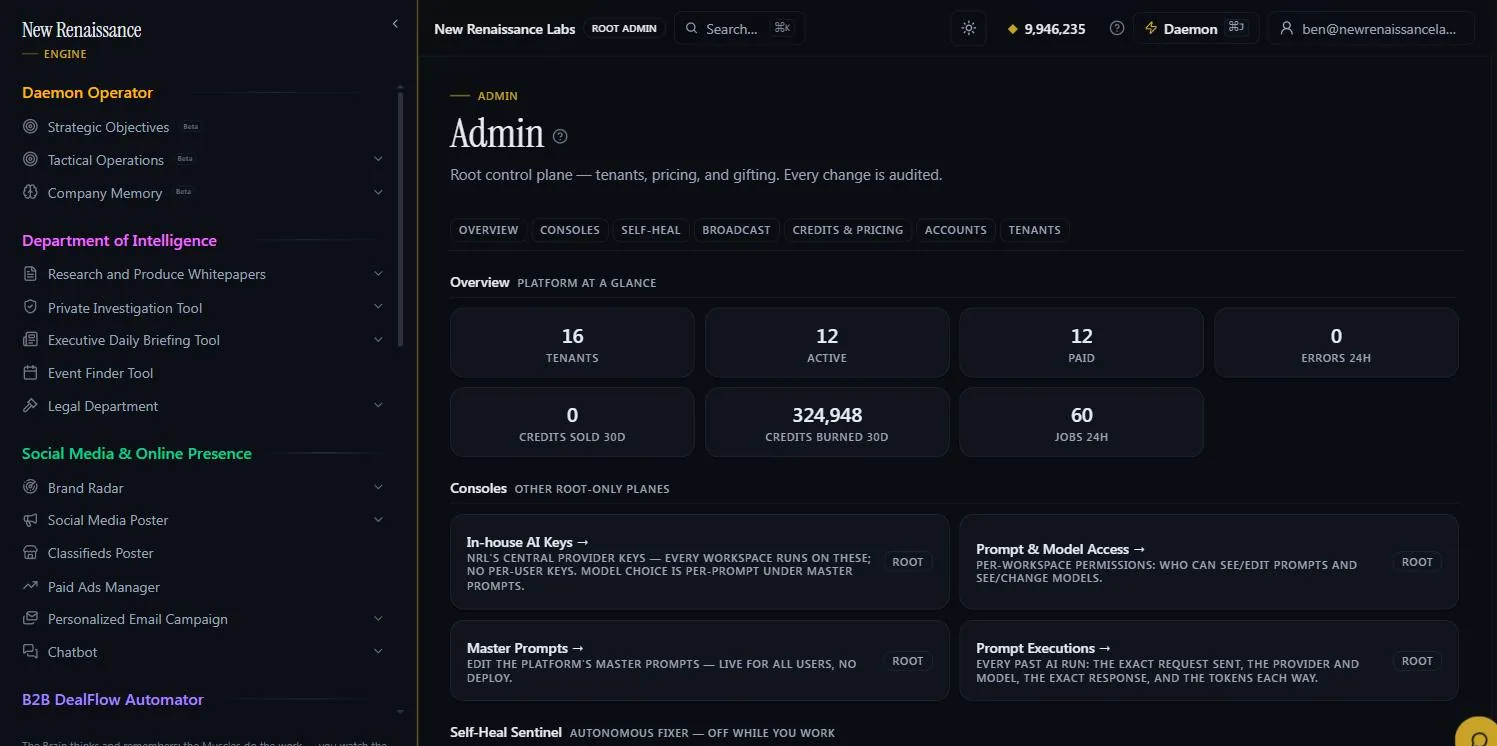
Today a portfolio is set up through the same console our partners use: one account, a credit pool, and a company per template. Each company is its own workspace, with its own memory and its own ledger, and nothing in one can read another.
LiveBuilt and running
- Set up a company in about two minutes, from a template — with its own departments, its own Company Memory, its own credit ledger and its own audit trail.
- Wholesale credit pools: buy credits once, grant them company by company, and read one statement.
- Cross-company audit: from the root view, every action in every company, on one append-only trail.
- One price sheet across the whole book; every run priced before it starts, refunded if it fails.
RoadmapNot built yet
- The cross-company cockpit — one screen with every company’s pipeline, spend and open decisions.
- The in-app company switcher.
Today you read one company at a time. The root view shows the whole book, and then you open each company to read it. That is the honest state, and it is the gap the roadmap closes first.
03 — The category
A name for what this is.
A business harness uses AI to run one company’s operations. A private equity harness runs every company in a portfolio.
The tools an operating partner already owns each do part of this. Palantir integrates the data, McKinsey writes the playbook and Oracle EPM consolidates the numbers after the quarter closes; none of them does the work inside the company. The Engine starts from the other end. It does the work in each company, on one ledger, so the consolidated view — the cockpit above — is a report on that ledger rather than another system to feed.
04 — The controls
What an owner can hold in every company.
The same four controls run in every company on the Engine, enforced by the system rather than by a policy memo. Nothing irreversible runs without a human yes: the AI Manager proposes a plan, and money and irreversible steps wait for a click. Every run is priced before it starts and refunded if it fails. Every action, by a person or by the AI, lands on an audit trail that cannot be edited or deleted. And AI never touches your billing; the ledger is plain database procedure.
For an owner of several companies that is the point. The controls are not a policy you ask each management team to follow. They are the way the system works, the same in every company, and the trail is there whether or not anyone remembers to write things down.
05 — How we prove it
We run real companies on it.
New Renaissance Labs operates real companies on the Engine — its own, and those of the clients it installs for — and publishes what it learns: what the departments do well, where an approval gate was too loose or too tight, what a month of credits actually buys.
The notes are plain: what ran, what it cost, what we changed afterwards. We do not publish client names, and we do not publish metrics we cannot read from the system. When a number appears on this site, it came from the live ledger, and the prices here are the prices a portfolio pays.
| What a company costs on the Engine | A month |
|---|---|
| Core1,500 credits a month | $149 |
| Growth5,000 credits a month | $349 |
| Scale12,000 credits a month | $749 |
| Ten companies on Growthten research desks, ten sales desks, ten bids desks — one bill | $3,490 |
| A 30-page cited reportin a single sitting, with a live ETA | 800 credits ($80) |
| A hundred scored leadswith a dossier each | 800 credits ($80) |
06 — For whom
Three to fifteen companies.
The thesis is for anyone who owns more than one company. The first cohort we are building for is narrower. If you own one company, start at how it works; if you want a reporting layer only, this is not it.
Independent sponsors
with a first platform and the second in diligence, who want the back office decided before the deal closes.
Search funds
after the acquisition, when the searcher becomes the person running the company.
Lower-mid-market funds
whose portfolio companies are too small for a shared services centre and too many for one head of operations.
Family holdcos
with three to fifteen operating companies and one back office between them.
Next step
Put one portfolio company on it first.
A private demo is a real workspace set up for one of your companies, with credits and an access password. Run a report, a lead list and a tender scan on it; read the ledger and the audit trail; then decide about the second company.