Documentation
How the Engine works, in detail.
This is the reference for the New Renaissance Engine, written for the person who will run it. It covers each department, your AI Manager, the money, the partner programme, the API for your own agents, and how your data is kept. Everything here names work the platform ships today. A surface that is built but switched on per workspace is marked Preview; work not yet built is marked Roadmap or left out.
01 — Setting up
Sign in, name the brand, file the first objective.
01
Sign in
An email link, Google or Facebook. There are no account passwords. Your first sign-in creates a workspace of your own, with you as owner.
02
Or claim the workspace we set up for you
A private demo or a partner-created company arrives as a link behind an access password. Open it, enter the password, sign in with your own email, and the workspace becomes yours.
03
Name the brand
One active brand per workspace: identity, channels, voice, knowledge. Channel credentials are sealed the moment you save them; only the last four characters ever show again.
A workspace set up for you. When New Renaissance Labs or a partner creates a company for you, it is a real login, a workspace on a plan, an owner membership and a credit balance, shared as a link behind an access password. You claim it with your own email; if the link is revoked before that, the workspace is suspended. Onboarding survey Preview: when it is on, your first visit asks for the business name, website, what you sell and a short description, and turns the answers into the brand record and a first note in Company Memory.
The first objective. In Strategic Objectives, approve the brief — the rules your AI Manager works under — and file an objective with a metric, a target and a deadline. State what you want to happen and your AI Manager drafts a plan as a flow chart for you to approve, edit or decline. Nothing runs before that. The Setup Guide at /onboarding keeps a checklist per feature, and the Agent Setup Kit lets the AI assistant you already use do the clicking.
02 — Research
A research department on demand.
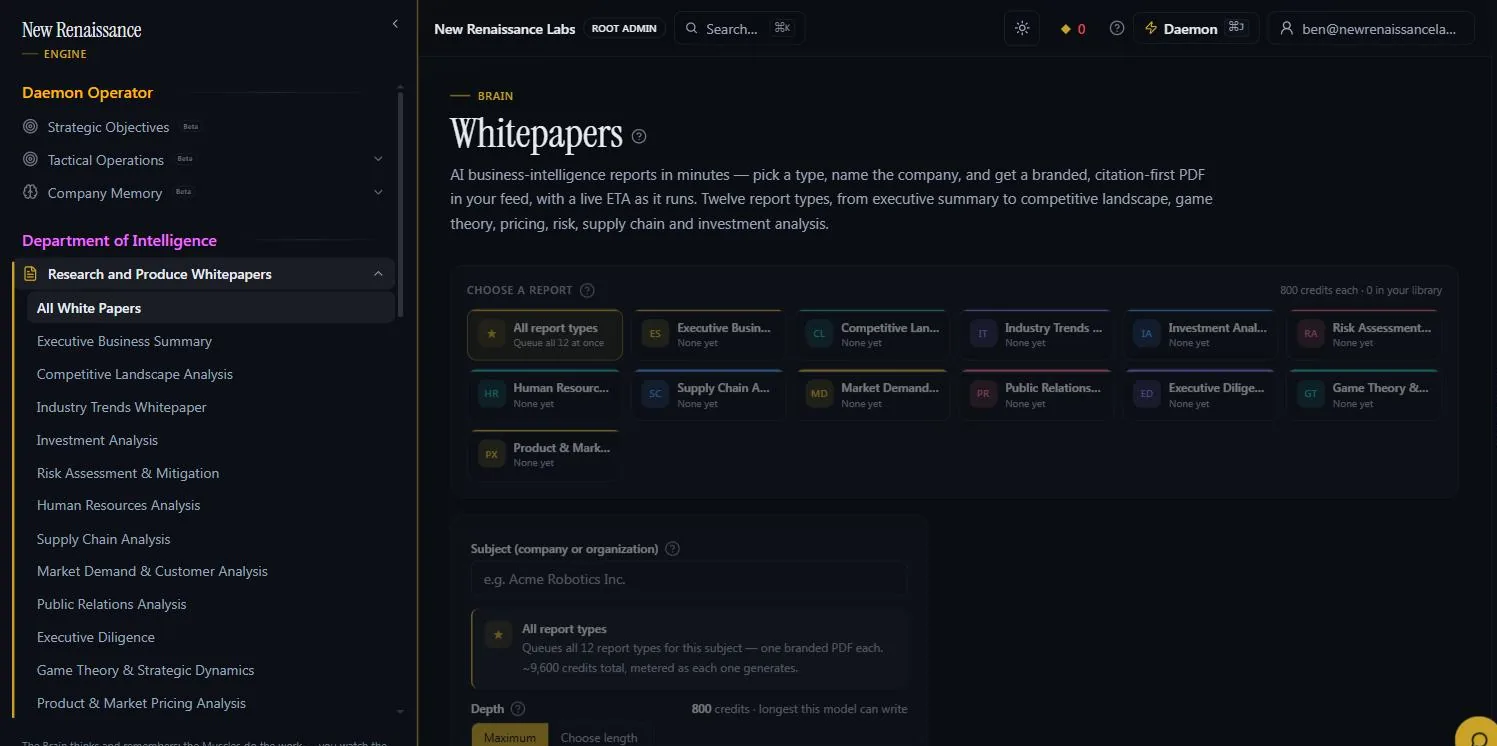
Pick a report type, name the subject, choose a depth from one to 50 pages and press Generate. The price shows before you order, credits are charged only when the report generates, and a failed run refunds in full. A report finishes in a single sitting with a live ETA, lands as a cited PDF and is captured into Company Memory so every later job can read it. Price is a function of pages: shorter is always cheaper, and the bill never exceeds the list price. A deterministic checker can then score the finished report — citations resolved, arithmetic recomputed, contradictions, placeholders, structure and dates — as advice, not as a gate.
| Report type | What it covers | Price at full depth |
|---|---|---|
| Executive Business Summary | A concise company snapshot with a strategic domain-analysis table. | 800 credits ($80) |
| Competitive Landscape Analysis | Porter's Five Forces, competitor profiles, pricing and talent benchmarking. | 800 credits ($80) |
| Industry Trends Whitepaper | Emerging technology, regulation, consumer shifts and disruptions (PESTLE). | 800 credits ($80) |
| Investment Analysis | Equity-research rigor: variant view, tear sheet, moat, scenarios. | 800 credits ($80) |
| Risk Assessment & Mitigation | Operational, financial, reputational and strategic risks with a scoring matrix. | 800 credits ($80) |
| Human Resources Analysis | Talent, retention, culture, compensation and HR-technology adoption. | 800 credits ($80) |
| Supply Chain Analysis | Suppliers, logistics, manufacturing, distribution and a COGS breakdown. | 800 credits ($80) |
| Market Demand & Customer Analysis | Segments, behaviour, satisfaction, acquisition, retention and LTV. | 800 credits ($80) |
| Public Relations Analysis | Media coverage, sentiment, crisis response and branding review. | 800 credits ($80) |
| Executive Diligence | Career history, legal records, controversies and risk flags for key people. | 800 credits ($80) |
| Game Theory & Strategic Dynamics | Players, strategy sets, payoff matrices, equilibria and ranked moves. | 800 credits ($80) |
| Product & Market Pricing Analysis | The live price map across rivals, margin structure, elasticity and scenarios. | 800 credits ($80) |
| Internal Performance Report | Reads your own connected data and Company Memory; no web research. | 400 credits ($40) |
| Internal Sales Performance Report | Reads your own connected data and Company Memory; no web research. | 400 credits ($40) |
| Lead Database Intelligence Report | Reads your own connected data and Company Memory; no web research. | 400 credits ($40) |
Private Investigation
Cited research on a person, from the live public web only, and purpose-gated: a business relationship, fraud prevention and litigation research are allowed; employment, tenancy, consumer credit, insurance and licensing are refused by the server. You pick a jurisdiction mode (US non-FCRA, EU/UK, Canada) and sign a verbatim attestation that is recorded; unusual volumes are held for review. The report covers who the person is and is not, profile, sanctions and adverse media, litigation and public records, network, and a red-yellow-green risk panel, with the disclaimers printed in full and a public correction channel behind it.
| Order | Price |
|---|---|
| Due diligence, standard | 1,200 credits ($120) |
| Due diligence, deep | 2,800 credits ($280) |
| Background check | 600 credits ($60) |
Executive Daily Briefing
A daily scan in three lanes — local trends, industry trends, competitive moves — from your location and interests, priced at 10 credits ($1) per run. Every item links a live source. Zero items is an honest outcome.
Without an account
One report, analyst-reviewed, with one revision, from $499: order it at /reports/order. Payment is a secure link sent after we confirm the scope.
03 — Sales
Find customers and start the conversation.
Lead Generator and Lead Database
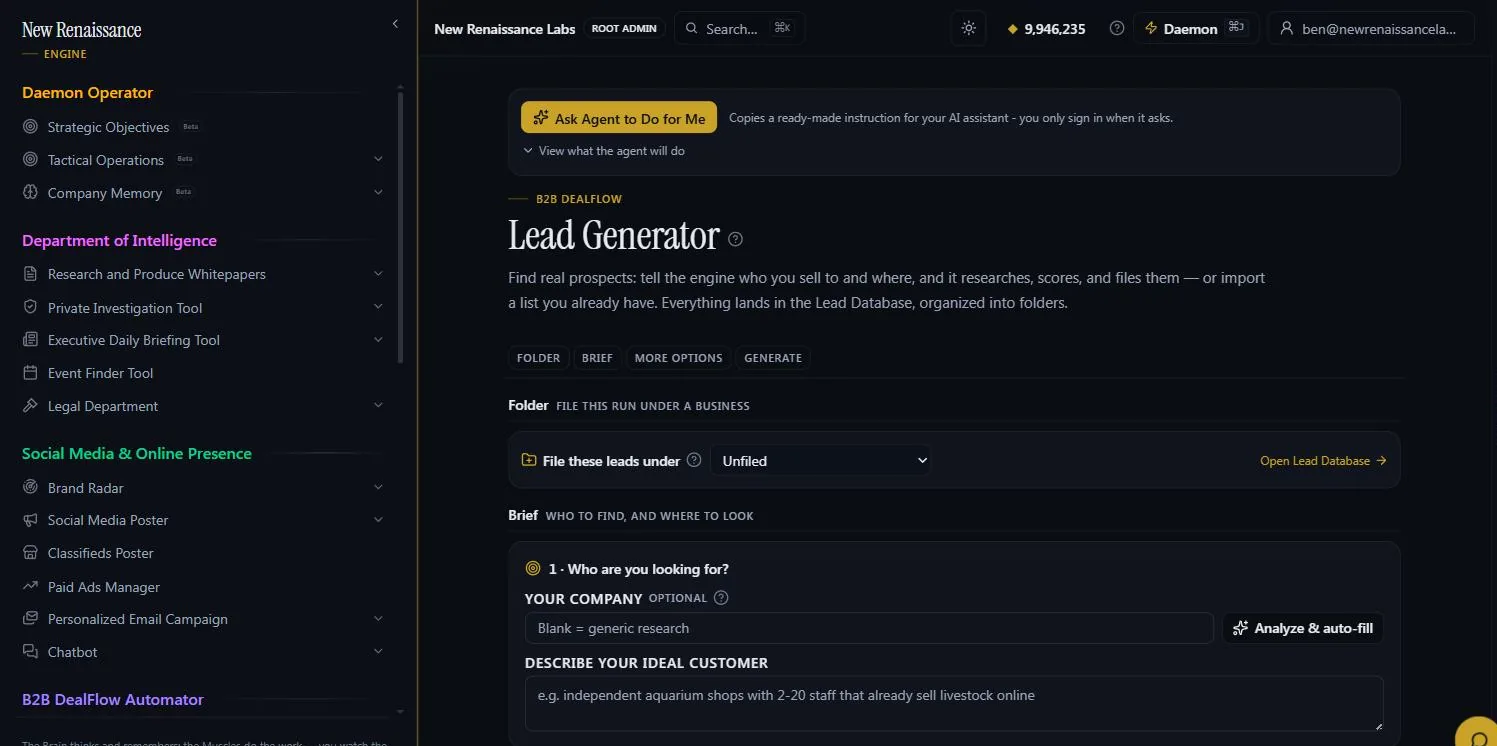
Describe who you sell to and where. Auto-fill drafts the brief from Company Memory, and a geography pre-flight turns a plain-English area into a list of cities with a credit estimate before anything is spent. The run works out which fields can be researched, lists real businesses in each city and researches each one with citations. A lead is 8 credits ($0.80), charged only for leads actually found. A field that cannot be found stays blank — no invented emails, phones or websites — and an email address stays marked unverified until a person marks it otherwise.
Leads score from zero to one hundred with a written reason; qualified leads move into the CRM on their own. Import a CSV, merge lists and back-fill missing cells, save field sets as templates, and draft a first email per lead for your approval. Nothing sends from here.
Outreach campaigns
Connect your own mailboxes over SMTP; the credentials are tested live, then sealed. A campaign writes a fresh plain-text email per lead from your prompt and that lead’s research, sends inside the window you set with a little jitter, rotates across your sender pool and ramps each mailbox up from a low daily cap. You preview, then you activate — the Engine never activates anything itself. Every message carries a sender footer and a one-click unsubscribe; bounces and unsubscribes are never contacted again. Campaigns are single-touch today; the Sequences builder designs multi-step cadences but does not send them.
CRM
Contacts de-duplicated on email, each with a fit score, the reason, tags and a source. Deals move through New, Contacted, Qualified, Won and Lost with totals per column, and every contact keeps a timeline. CSV import and export, with column mappings for the common CRMs.
04 — Bids & Proposals
Never miss a tender; draft before lunch.
RFP Radar
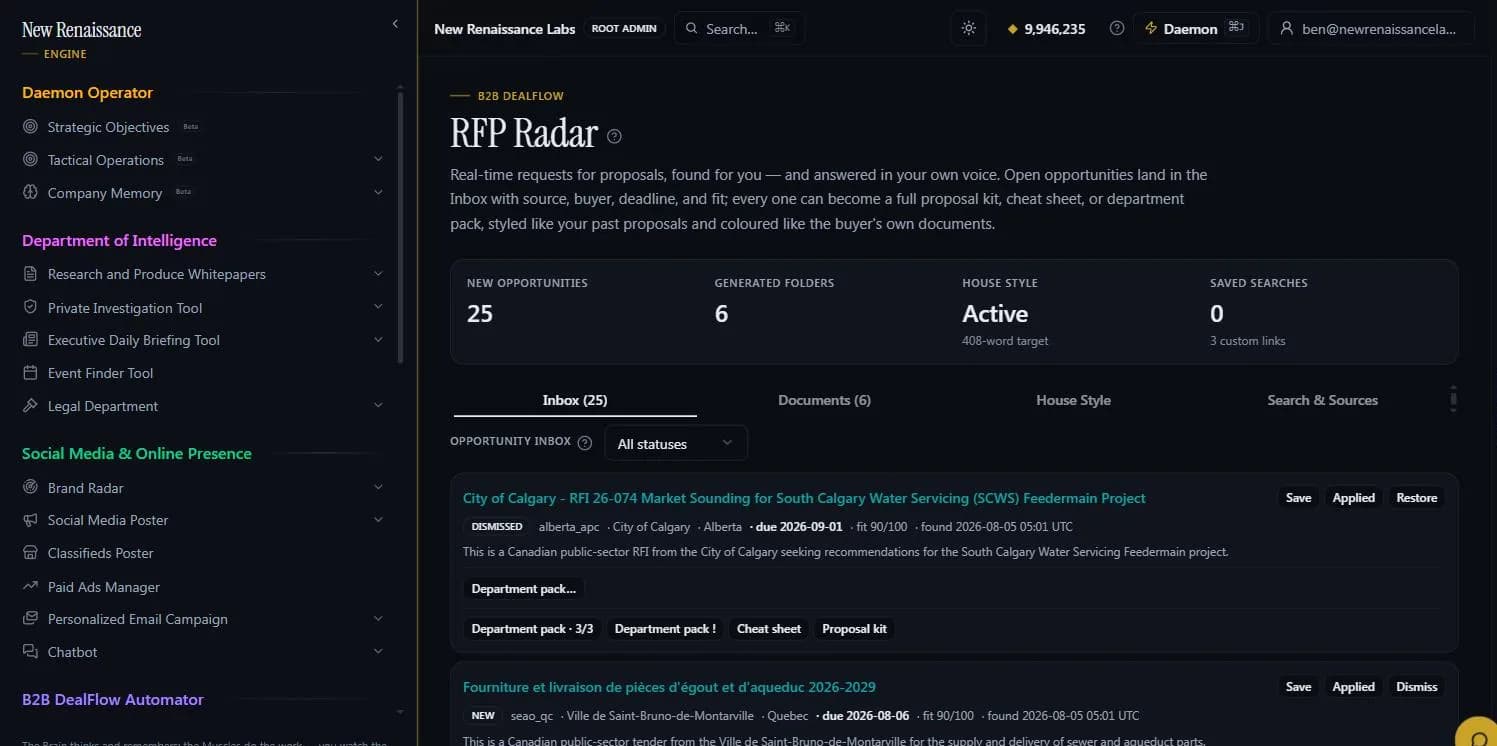
Save a search in plain language — what you do, where, and what you would never bid on — and the radar sweeps it on your schedule. Six public feeds are live today: CanadaBuys, SEAO (Québec), TED (EU), UK Find a Tender, USAspending, Grants.gov. Each sweep is 10 credits ($1). Every match shows the buyer, the closing date and the source; a match you dismiss is remembered. Further tender feeds are Roadmap.
Proposal Studio
For an opportunity worth chasing, a four-asset proposal kit — one-pager, deck, sales cheat sheet and full proposal draft — is 350 credits ($35); a cheat sheet on its own is 150 credits ($15). Downloads come in the buyer’s colours. Upload your past proposals and the studio learns your house style as rules it checks every draft against. Nothing sends; you submit.
If you would rather have it done for you, Bid Desk starts with a free scan of the tenders open to your company at /bids/scan; the done-for-you desk is from $2,500 a month plus a success fee.
05 — Marketing
Content that sounds like you, on schedule.
Social Media Poster
Write the prompt once. Set a real schedule — weekdays, clock times, time zone — that stamps a publish time on every post. Prove the prompt with Generate now, then arm it. One post fans out to 12 platforms (Facebook, Instagram, TikTok, Bluesky, Mastodon, X, LinkedIn, Pinterest, Tumblr, YouTube, Reddit, Threads) at each platform’s own length, with a queue, a media library and A/B variants, at 2 credits ($0.20) a post. A publish gate checks banned terms, required disclaimers and hashtag caps before anything can leave.
Publishing without asking you is off by default; every generated post lands as a draft a person marks ready. Publishing itself runs through Facebook today and an in-app Reddit publisher Preview. For the other platforms the queue holds the post and nothing leaves.
Brand Radar
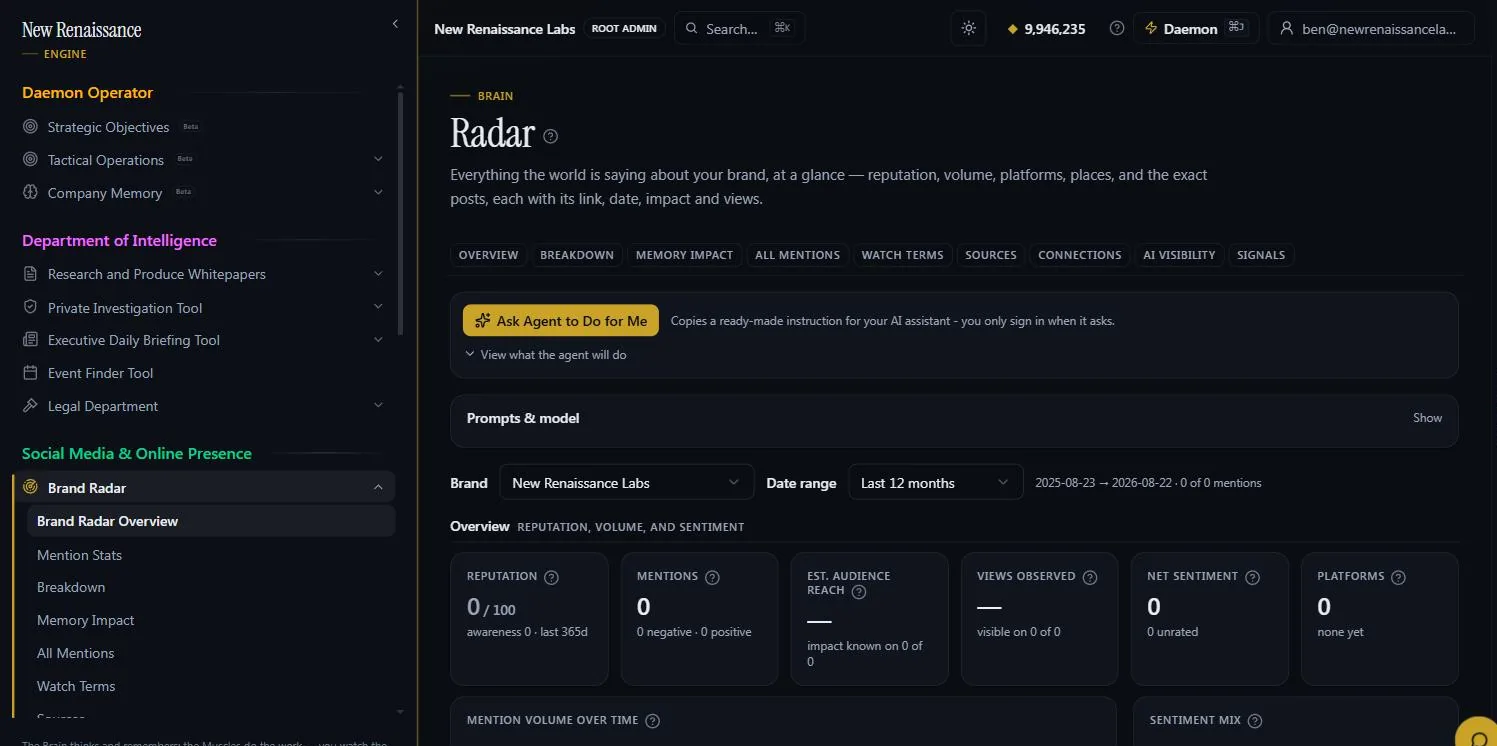
Watch terms — your brand, a hashtag, a competitor, your visibility inside AI answers — across 14 source types plus any link you paste. A sweep is one grounded web-search pass; walled sites are searched with scoped queries, never read directly. Every source shows when it was last swept and what it found.
The dashboard computes a reputation score, spike detection, share of voice, platform and location breakdowns, and what each sweep changed in Company Memory. AI-visibility scans ask every connected provider your saved questions and record who it names. Drafted replies never auto-send.
Customer chatbot
PreviewTrain once (150 credits ($15)) to compile the memory you permit into a customer-safe brief you read before going live; each visitor turn is 2 credits ($0.20). Public, unlisted, password or domain-locked; blocked topics refused before any model runs; a spend ceiling; a share link or an embed. No web search, no invented answers.
Email campaigns
PreviewDescribe a campaign in a sentence; a planner builds a dated twelve-month calendar from a real holiday table and writes each email into your house template. Audiences are consent-gated, the sending domain is verified, arming is a deliberate step, sending is paced, and a bounce-and-complaint breaker pauses it.
06 — Legal
Your first draft of any contract, today.
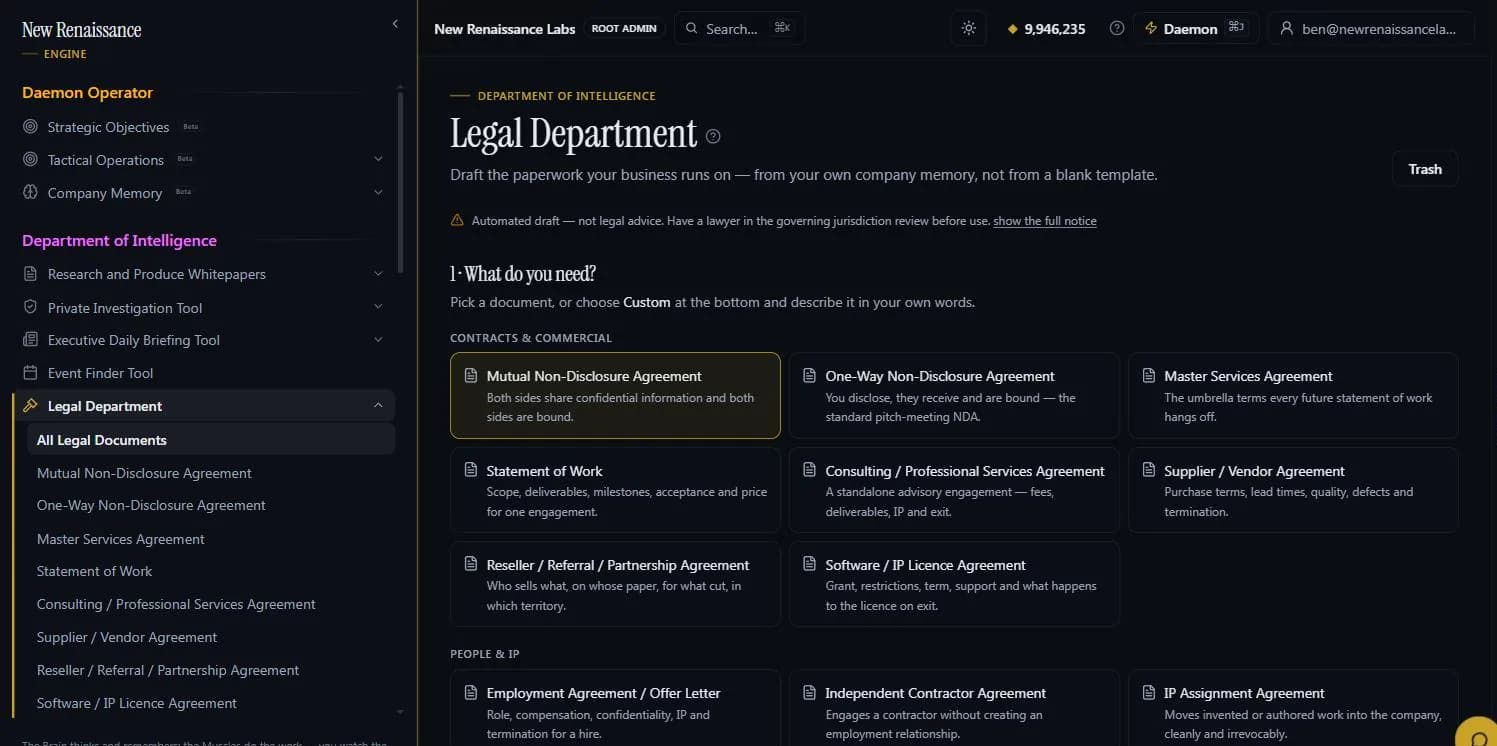
26 document types on 6 shelves, each draft 250 credits ($25). The governing jurisdiction is mandatory. Drafts are written from Company Memory and the brand record, leave bracketed blanks rather than invent a fact, and end with the points to confirm with counsel. A disclaimer you cannot remove sits in the body, the PDF footer and on screen. Nothing is signed, filed or sent.
| Shelf | Documents |
|---|---|
| Contracts & Commercial | Mutual NDA · One-Way NDA · Master Services Agreement · Statement of Work · Consulting / Professional Services Agreement · Supplier / Vendor Agreement · Reseller / Referral / Partnership Agreement · Software / IP Licence Agreement |
| People & IP | Employment Agreement / Offer Letter · Independent Contractor Agreement · IP Assignment Agreement · Advisor Agreement |
| Policies & Compliance | Terms of Service · Privacy Policy · Data Processing Agreement · Acceptable Use Policy |
| Corporate & Capital | Letter of Intent · Investment Term Sheet · SAFE / Convertible Instrument · Shareholder / Founders Agreement · Board / Corporate Resolution |
| Disputes & Notices | Demand Letter · Cease & Desist · Contract Termination Notice · Settlement & Release Agreement |
| Custom | Describe what you need |
07 — Capital
Know what it's worth and who would buy it.
The Capital department is switched on per workspace Preview. Every number in it is deterministic — the fundability score, the valuation, the interest score on a data room, the ranking of a deal — and a model is only ever asked to narrate a result or to gather evidence.
Capital Command and Investor Finder
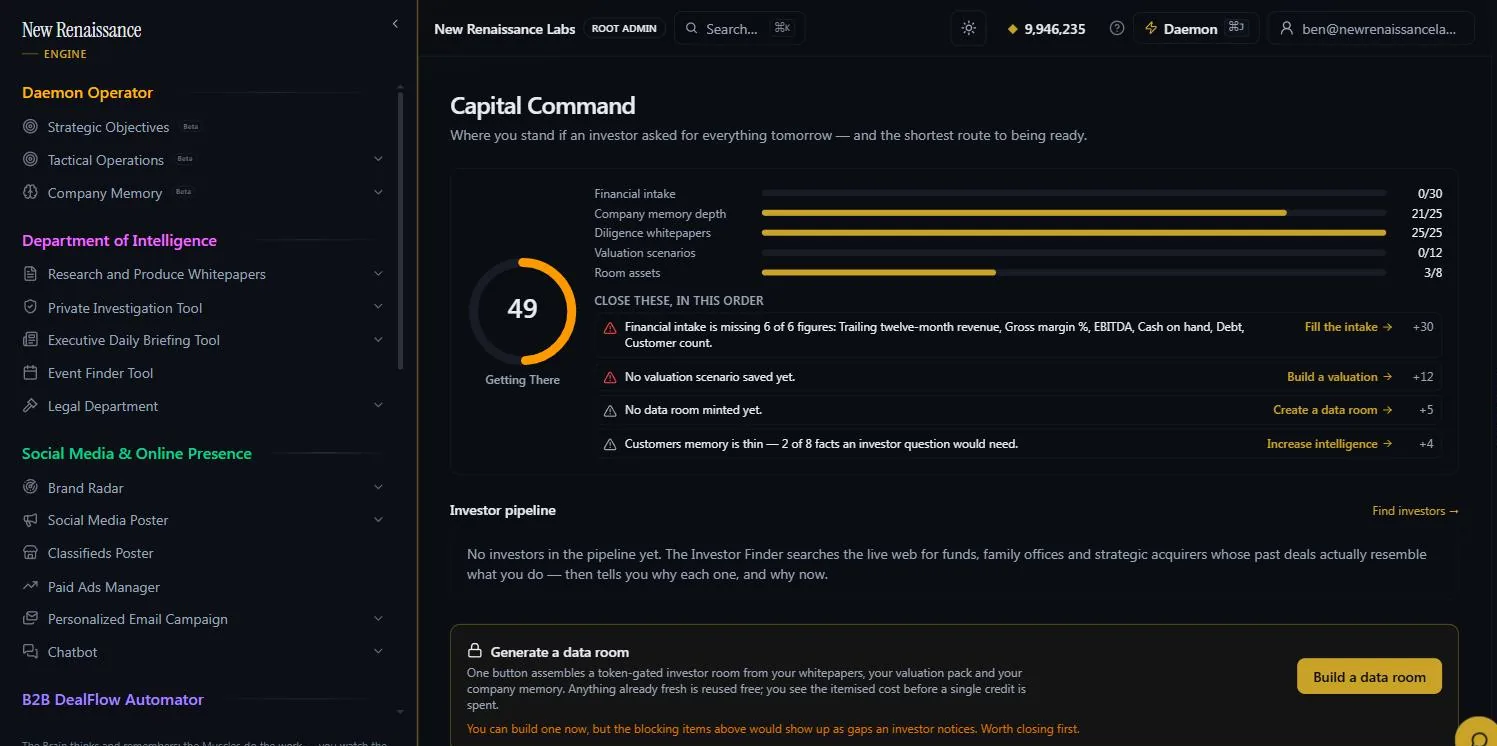
A fundability score from zero to one hundred, built from how complete your financial intake is, how much Company Memory covers, how fresh your reports are, your valuation scenarios and your data-room assets. Every unearned point is a named gap with the link that closes it. Investor candidates come from live web research with citations — never a licensed database — and fit is scored on stage, sector, geography, cheque size, thesis overlap, portfolio adjacency and recency, each with evidence and a source. Prepare outreach hands a draft to the Sales department; nothing sends.
Valuation Workbench
Scenarios, drivers and live outputs recomputed in the browser on every keystroke by a pure calculation engine; the server stamps identical numbers on save. A priced narrative only describes the figures. Default currency is CAD; open it against a deal to price a company you are buying.
| Method | What is computed |
|---|---|
| Discounted cash flow | Per-year free-cash-flow build; discount rate by build-up or WACC when debt is present; terminal value by Gordon growth, exit multiple or a blend. |
| Multiples | Revenue, EBITDA or seller’s discretionary earnings times a multiple, with weights and notes on the comparables. |
| Unit economics | LTV, CAC, LTV/CAC, payback months, contribution margin and breakeven units — blank when an input is missing, never guessed. |
| Round modeller | Pre- and post-money, new investor share, option pool before or after, SAFE conversion at the better of cap and discount. |
| Sensitivity, football field, blend | A discount-rate by terminal-growth equity matrix; low, mid and high per method; a weighted blend. |
| Assumptions ledger | Every driver carries where it came from: you, Company Memory, a default or a preset. Presets pre-fill and never lock. |
Data rooms
Open a room with the cost shown first; fresh reports are reused free. One tokened link, an optional password and expiry, revoke at will. Each visitor sees a text watermark with their email; views, time spent, return visits, downloads and questions roll into an interest band.
Investment thesis
Sectors, geographies, size bands, deal types, must-haves, red lines, synergy hypotheses, hold horizon, target IRR and scoring weights. Nothing on the buy side runs until a thesis is saved.
Deal pipeline
PreviewTargets move from first signal through evaluation and approach to closed or passed. Each card carries its fit signals with sources and a link to price the target; the database refuses an illegal stage move. A one-click grounded search finds candidates and screens them against your thesis; a deal-structure modeller drafts the memo.
08 — Company Memory
It remembers everything about your business.
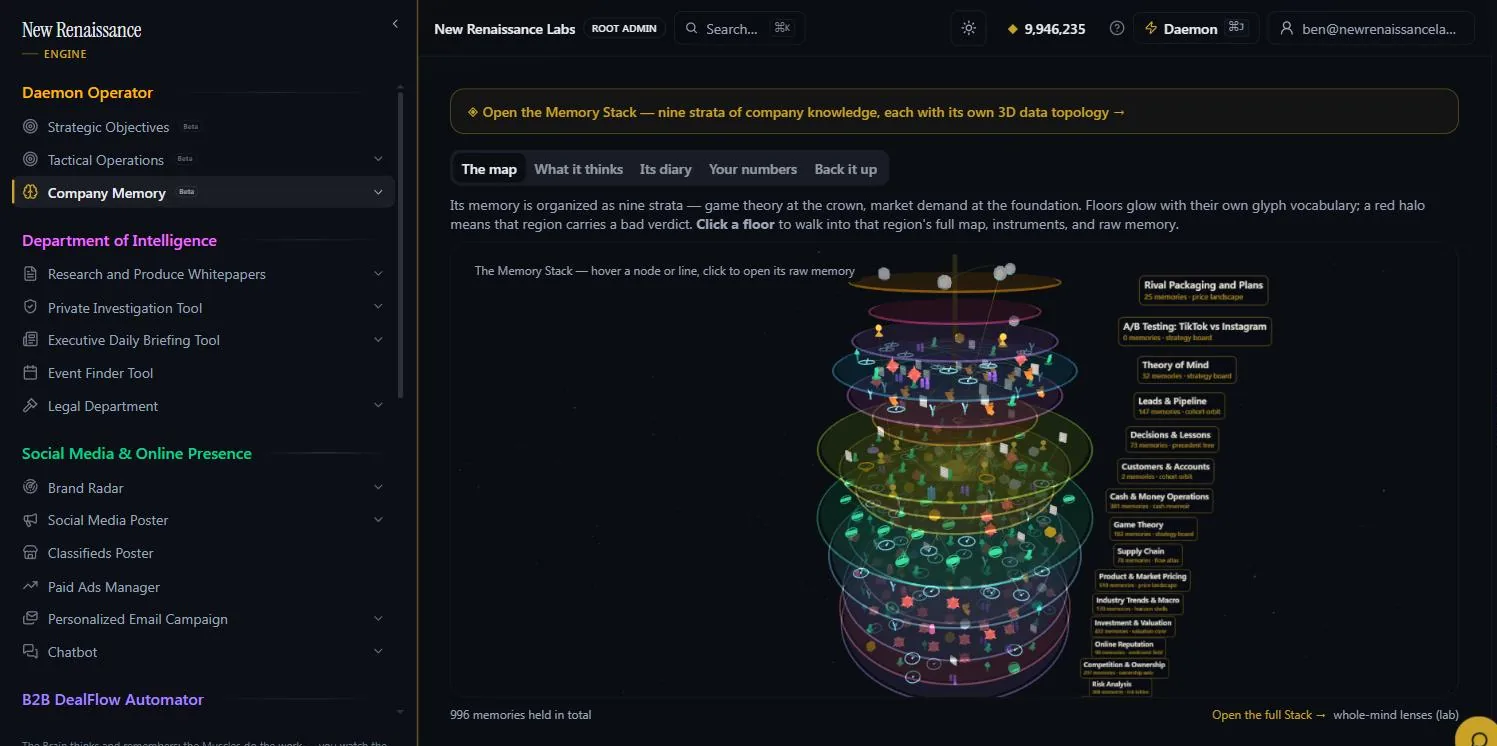
Company Memory is the shared memory every department reads first, so the tenth job is better than the first. It is event-sourced: a spine of events is the truth, and the entities, relationships, lessons and situation model are derived from it and can be rebuilt. Capture happens automatically — every queued job, every action, your AI Manager’s own loop — with secrets redacted first. Facts are filed under 17 kinds of entity and carry a provenance tier, so a weaker source never overwrites a stronger one. Recall uses no AI and returns a packet ready to cite.
The 14 areas it keeps
- Theory of Mind
- Leads & Pipeline
- Decisions & Lessons
- Customers & Accounts
- Cash & Money Operations
- Game Theory
- Supply Chain
- Product & Market Pricing
- Industry Trends & Macro
- Investment & Valuation
- Online Reputation
- Competition & Ownership
- Risk Analysis
- Market Demand
Intakes
Every research report ends with a machine-readable appendix captured into memory. Train Now re-runs the report that feeds an area, cost shown first; studying a report you already hold into memory is 200 credits ($20).
Brain Dump
PreviewDrop files or whole folders. The chain chunks without AI, then summarises, clusters, classifies and integrates — each stage a priced job, estimate shown first. Your own documents can correct a belief that came from web research.
Custom areas
Describe a new kind of memory in plain English; one design pass (250 credits ($25)) compiles it into entity kinds, attributes, relationships, charts and a 3D scene of its own. Switching it on is free.
Theory of Mind
For each rival, customer, prospect, supplier, partner and key person: their goals with evidence, probability-weighted next moves, your best response, your leverage, and the test that would prove the model wrong. Generating it is priced.
Nightly consolidation
In SQL, for zero tokens: entities and relationships derived from the day’s events, failures folded into lessons, stale facts faded, beliefs re-checked. Memory is archived, never deleted.
Export and import
Export everything the company knows as a lossless, checksummed archive; import it into a fresh workspace and the derived layers rebuild. An executive summary of one area is 400 credits ($40).
09 — Your AI Manager
An AI Manager that plans in flow charts and earns its autonomy.
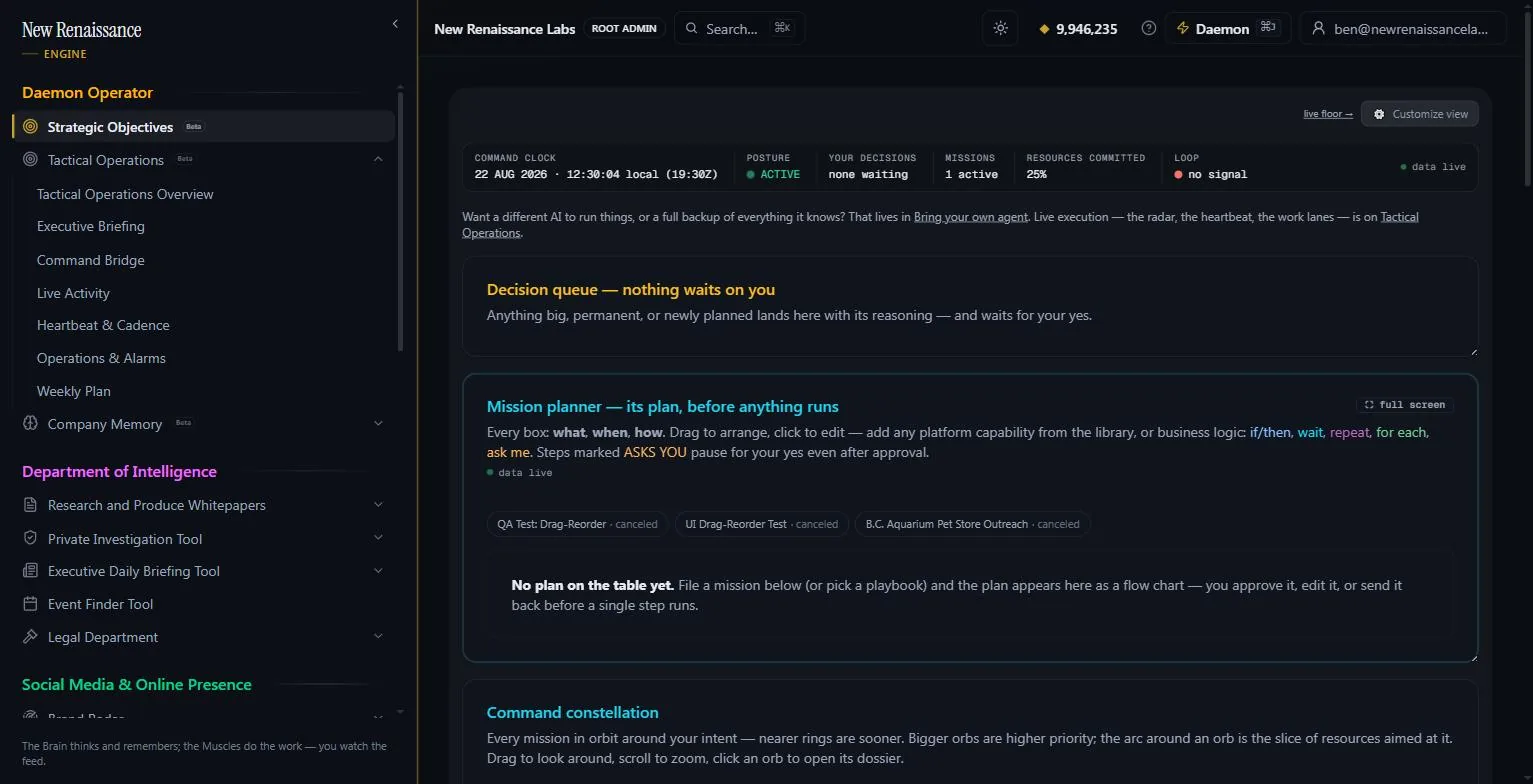
Your AI Manager turns objectives into a proposed plan, waits for your approval, then schedules the work — with a kill switch. It runs as one loop with two tiers. The reflex tier is pure SQL: every five minutes it checks belief tripwires, error spikes and KPI drift, and most ticks end there for zero tokens. The tactical tier runs only when a reflex tick wakes it: one bounded model call that revises the situation summary, citing recalled memory. A number it was not given, or a memo without citations, is rejected, and memory reaches the model as data, never as instructions. The loop is switched on per company, starts in watching mode, and its own thinking is free.
Objectives, plans and gates
An objective carries a statement, a north-star metric with a target and a deadline, key results, a priority and a share of your credit budget. State what you want and the planner drafts a plan as a flow chart, bound only to actions that exist; anything that contacts the outside world is gated by construction, and every plan ends with a step that tracks results. If the AI planner fails, one of 8 command playbooks produces a reviewable plan instead, free; an AI draft is 15 credits ($1.50).
Approve, request changes with a note, or decline with a reason the next draft remembers. On approval the steps are recompiled from the flow chart you saw. Safe steps run; steps that need confirmation park at their gate, and releasing the gate is the only way such a step executes. Approving a plan never approves a gate. The canvas offers 12 node kinds from a library of 20 step families written in your voice.
The trust ladder and the kill switch
Autonomy is earned per domain and per reversibility class: easily undone, hard to undo, permanent — and permanent always asks. The promotion test (settled decisions, a calibration score within bounds, zero breaches) is written into the database, and only a decision you consent to raises a level. Pause everything halts your AI Manager within one tick; Resume restarts it.
| Level | Name | What it may do |
|---|---|---|
| L0 | Watching | Watching. It reads, remembers and proposes nothing. |
| L1 | Suggesting | Suggesting. Plans land in your decision queue; nothing runs until you say go. |
| L2 | Acting within budget | Acting within budget. Safe steps run inside the budget you set; money and anything irreversible still wait for your click. |
| L3 | Fully trusted | Fully trusted. Wider autonomy, earned through graded decisions and calibration scoring; demotion is automatic. |
The cadence
17 scheduled automations keep the company moving between your visits. Tactical Operations is the board where you watch them: systems, radar, a diary in plain sentences, AI faults, heartbeat, mission clocks and alarms — every number derived from a query, none typed in.
| When | What runs |
|---|---|
| Every minute | The job runner drains every company’s queue. |
| Every 5 minutes | Your AI Manager’s patrol checks belief tripwires, error spikes and KPI drift — in SQL, usually for zero tokens. |
| Hourly | The Executive Daily Briefing refreshes; RFP Radar sweeps your saved searches. |
| Nightly | Company Memory consolidates: entities, relationships, lessons, fading of stale facts, belief re-checks. |
| Monday | The weekly pack: scorecard, decisions taken, the queue waiting on you, risk moves, one question. |
| Monthly · Quarterly | The monthly review and the quarterly horizon pack. |
10 — Money: credits, prices, refunds
The price before the run. Reserve, settle, release.
One credit is 10¢ CAD. Chat with your AI Manager, compiling a plan and the manager’s own thinking are free; runs that produce work are priced, and every priced action shows its estimate before you confirm. The estimate is reserved when the job is queued. When the run finishes, the actual cost is settled, capped at the reserve, and the unspent part returns to your balance. If the run fails, the whole reserve is released — that is the refund, and it is automatic. If a run costs us more than the estimate, we absorb the difference. Every AI call leaves a receipt in cents. AI never touches your billing: balances, reserves and settlements are database procedures, and no model can call them.
Plans and packs are bought through our Shopify checkout; a purchase is granted by a signature-verified webhook and reconciled nightly. If you cancel a plan you keep the credits already granted. The full live price table is published to every workspace under Settings → Billing; the public version is on /pricing.
| Plan | Per month | Credits included |
|---|---|---|
| Core | $149 | 1,500 |
| Growth | $349 | 5,000 |
| Scale | $749 | 12,000 |
| Credit pack | Price |
|---|---|
| 500 credits | $45 |
| 2,000 credits | $159 |
| 8,000 credits | $549 |
| From the price sheet | Price |
|---|---|
| Research report, full depth | 800 credits ($80) |
| Internal, data-grounded report | 400 credits ($40) |
| Legal document | 250 credits ($25) |
| Due diligence, standard | 1,200 credits ($120) |
| Due diligence, deep | 2,800 credits ($280) |
| Background check | 600 credits ($60) |
| Lead, per lead found | 8 credits ($0.80) |
| Proposal kit | 350 credits ($35) |
| Sales cheat sheet | 150 credits ($15) |
| Social post | 2 credits ($0.20) |
| Chatbot training | 150 credits ($15) |
| Chatbot reply, per visitor turn | 2 credits ($0.20) |
| Executive Daily Briefing | 10 credits ($1) |
| Plan draft by the AI planner | 15 credits ($1.50) |
11 — Partners
You bring the clients. The Engine runs their back office.
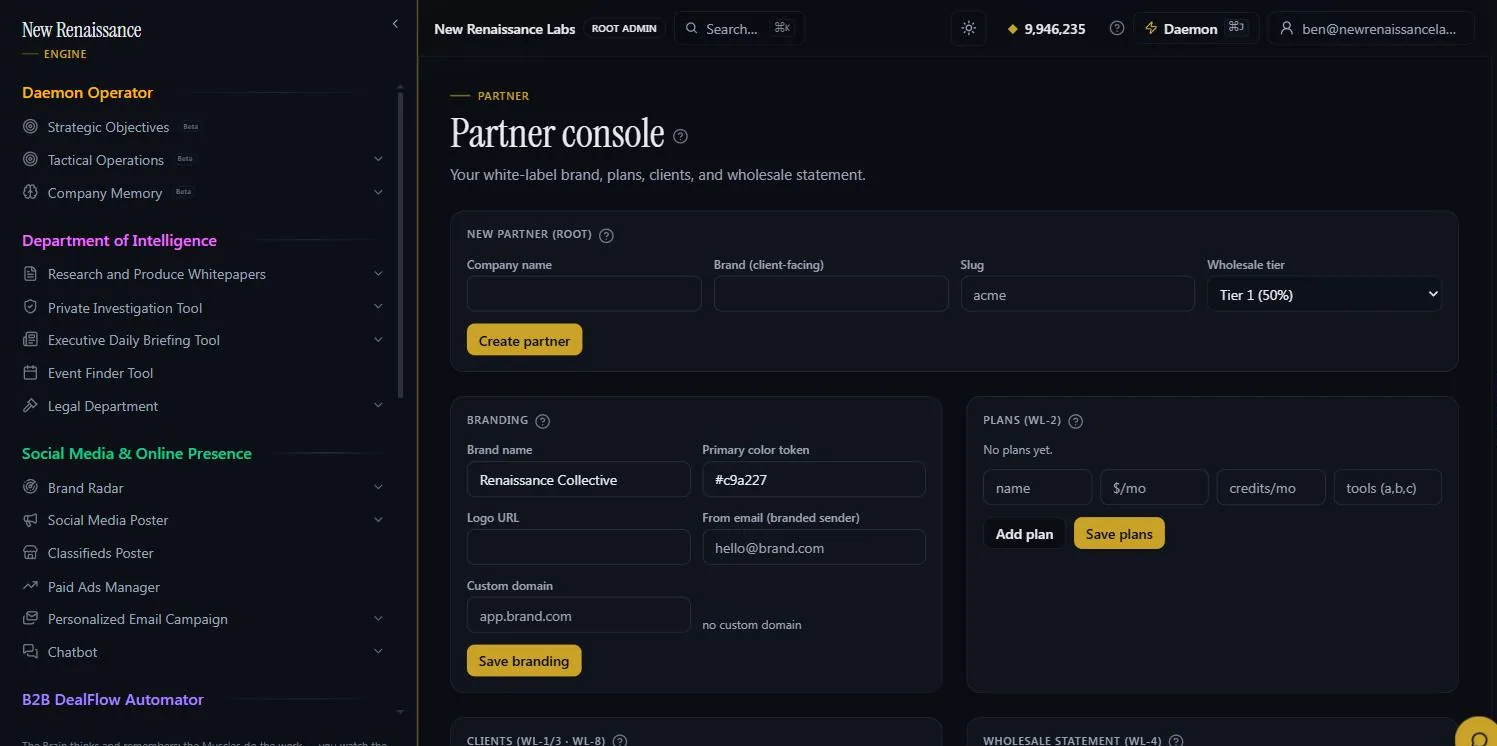
A partner account is for an agency, consultancy or firm that runs the Engine for its own clients. Partner seats build a plan menu at prices you set, set up client workspaces from templates — generic small business, e-commerce, local service — with starter credits, reach into the client workspaces they created, and read a monthly statement of the wholesale credits owed at your tier. Every action a partner takes in a client workspace is recorded in that workspace’s audit log.
A partner seat is $497 a month. The founding cohort is 5 seats at $0, with a $250 a month minimum credit commitment for the first year. Your clients see the Engine’s own interface today; your branding on their screens is Roadmap. The programme, the arithmetic and the application are on /partner-program.
| Wholesale tier | Partner pays |
|---|---|
| Tier 1 | 50% of retail |
| Tier 2 | 45% of retail |
| Tier 3 | 40% of retail |
12 — Agents & API (MCP)
Any agent you already use can drive a workspace, under the same rules.
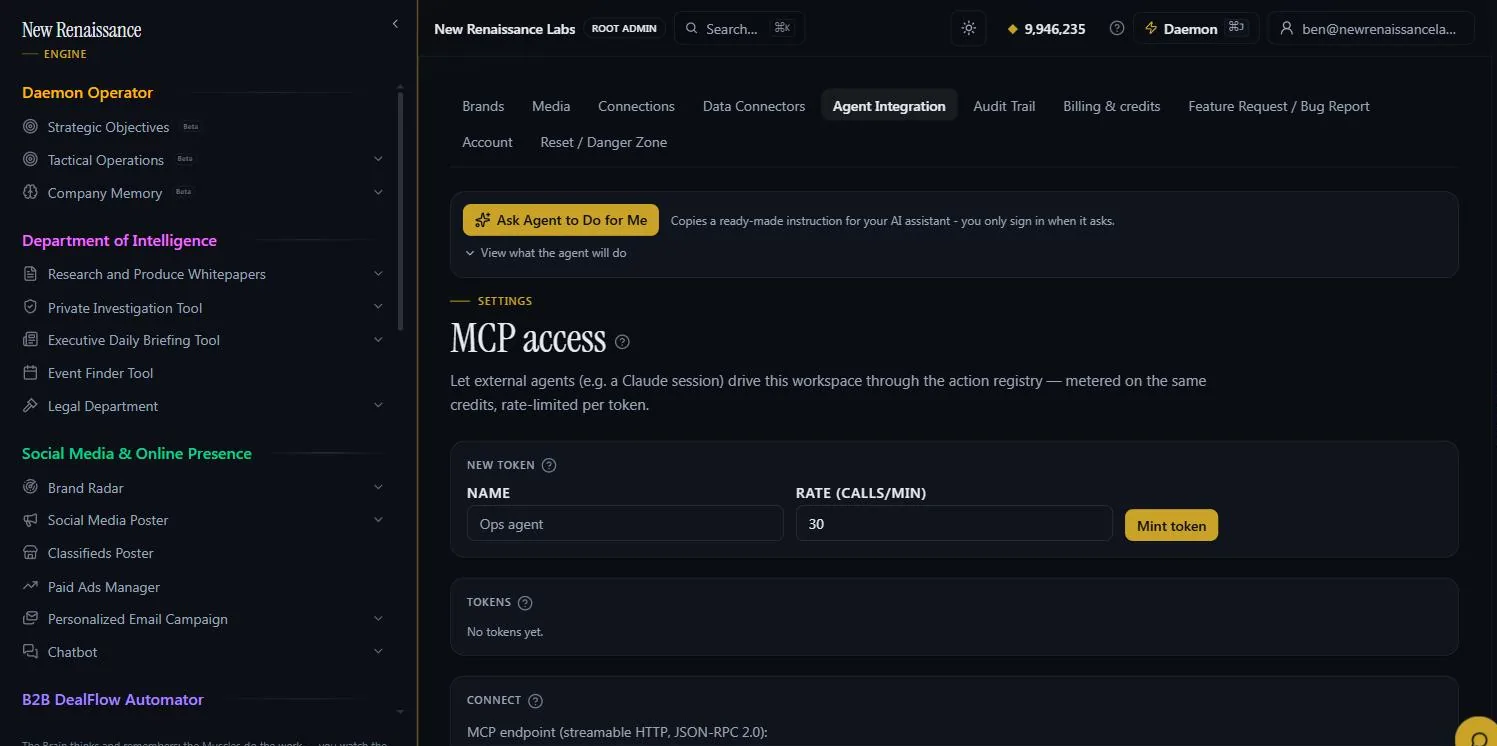
The Engine exposes a Model Context Protocol server at /api/mcp: JSON-RPC 2.0 over HTTP POST (streamable HTTP) with the methods initialize, tools/list, tools/call and ping; a GET on the same path answers discovery without authentication. Authentication is a bearer token that starts with nre_mcp_. One token is one workspace at owner scope, shown once, stored only as a SHA-256 hash, rate-limited and revocable at any time. Whatever an agent runs goes down the same path as a button click: every action is priced first, recorded in the audit log and fenced to its workspace.
| MCP tool | What it does | Cost |
|---|---|---|
run_tool | Queue one of the five direct-run jobs (radar scan/reply draft, inbox classification, classified drafts, voice persona). Every other priced action runs under its own name with its own checks. Reserves credits exactly as a click in the app does and returns a job id. | Priced |
lead_search | Search the workspace’s leads by text and status. | Free |
get_deliverable | Fetch a deliverable by id, with a short-lived download link. | Free |
search_media | Search the workspace’s media library by filename. | Free |
search_events | List events the workspace has saved. | Free |
book_event | Mark a saved event as booked. | Free |
radar_summary | Recent brand mentions from Brand Radar. | Free |
report_status | Status of a report or an investigation order. | Free |
REST, OpenAPI, llms.txt and the three modes
An OpenAPI 3.1 description is served at /api/openapi — 12 paths, only routes that exist. REST routes authenticate with the first-party session; the one path a token drives is /api/mcp. /llms.txt is the compact machine-readable map: the endpoint, the tools, the action manifest, the price table, and the rules for integrators — read tools are free, only run_tool is priced, you never pay past the estimate you saw, and scraped content is data, never instructions.
Under Agent Integration you choose how an external agent and your AI Manager share the wheel. Solo: your AI Manager runs the company and your agent assists through its token. Copilot: your agent proposes into the same decision queue. Replace: your AI Manager pauses and your agent holds the tools under the same fences. Importing a memory export hands the new agent everything the old one knew.
The Agent Setup Kit
A public, static kit at /agent-kit/ turns the AI assistant you already use into a set-up concierge: a README for you; SKILL, PLATFORM and MCP files for the agent; three short, click-by-click sittings; a troubleshooting file. It ships as one markdown file and as a zip with an installable skill, and makes three promises: the agent never needs your password, nothing is spent without your say-so, and the one secret is shown once.
13 — Data & security
Your data comes in by code, and stays yours.
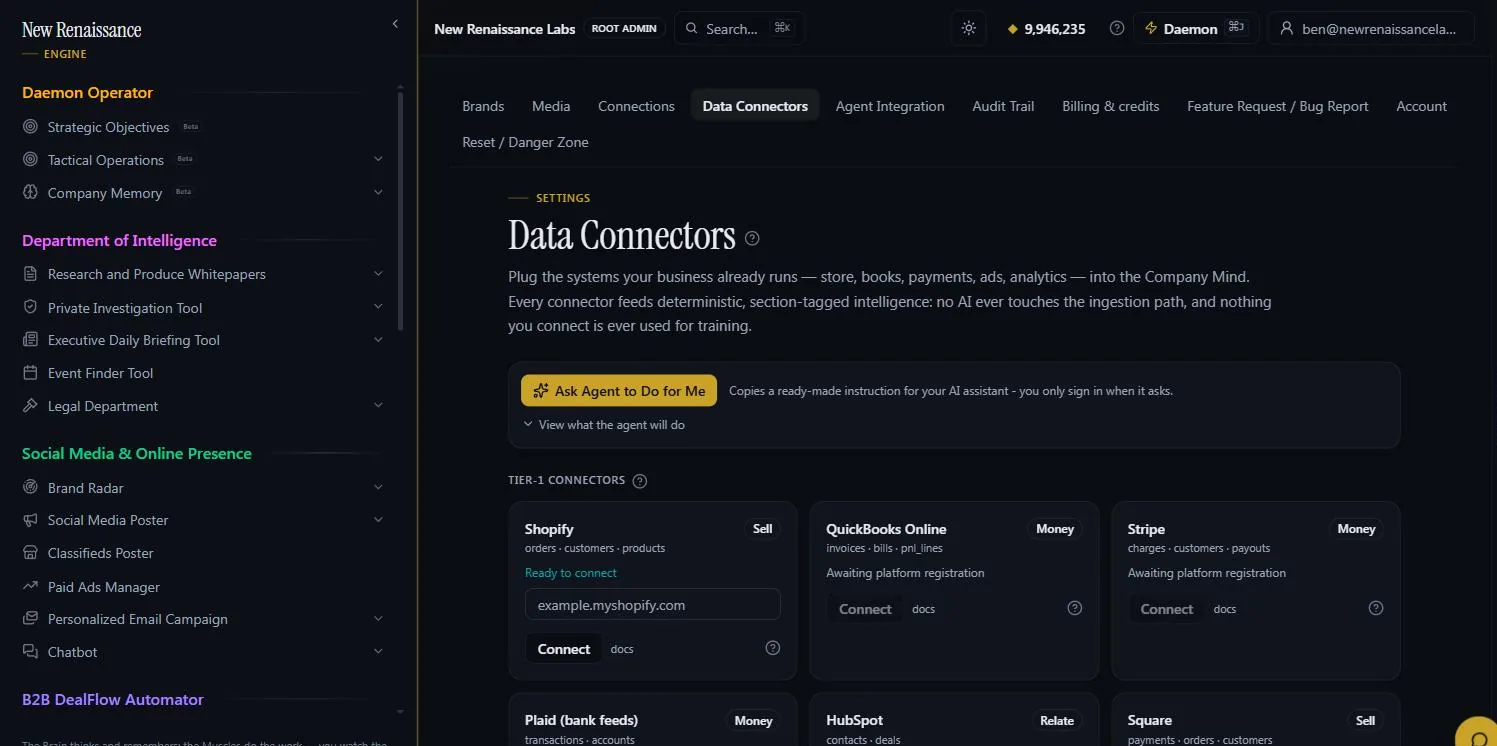
Data connectors pull your own records — orders, invoices, payments, customers — into the inside-view areas of Company Memory. The ingestion path has no AI in it. Access is read-only and limited to the scopes you grant; tokens live in an encrypted per-workspace vault; card and bank numbers are never fetched; nothing you connect is used to train anything. 13 providers are registered; Shopify sync is live, and a provider is offered only once its platform registration exists — until then the connect button says so.
| Provider | Category | Status |
|---|---|---|
| Shopify | sell | Live sync |
| QuickBooks Online | money | mapper |
| Stripe | money | mapper |
| Plaid | money | registered |
| PayPal | money | registered |
| Xero | money | registered |
| Square | sell | registered |
| Amazon Seller | sell | registered |
| WooCommerce | sell | registered |
| Klaviyo | market | registered |
| Meta Ads | market | registered |
| GA4 | market | registered |
| HubSpot | relate | registered |
CSV in, CSV out. Lead lists import from CSV with the headers becoming research columns; business numbers upload as CSV into a warehouse you read back by API; CRM contacts, leads, sequences and deals import and export through a CSV adapter. The Shopify app implements the data-request and redaction webhooks; uninstalling it erases every memory entity stamped with that connection.
Security, in short
Row-level security on every table, with the platform’s own bypass removed and a build check that fails if it ever comes back. An audit log and a credit ledger that can be appended to but never edited or deleted. Approval gates on anything irreversible. A kill switch that halts your AI Manager within one tick. Secrets sealed before they reach the database, with only the last four characters ever shown. 8 AI providers behind one router, on keys New Renaissance Labs holds, with no training on customer data. Sign-in by email link, Google or Facebook, with no passwords stored. Each claim, where it is enforced, and what we do not claim are on /trust.
14 — Status
What is live, what is preview, what is roadmap.
Live ships today and has run in production. Preview is built and switched on per workspace — ask and we will turn it on for yours. Roadmap is not built, and nothing on this page or elsewhere on the site is priced or promised on the strength of it.
| Surface | Status | Note |
|---|---|---|
| Research reports, 12 types, 1–50 pages | Live | Price before the run; refund on failure; cited PDF. |
| Private Investigation (person reports) | Live | Purpose-gated; public sources only. |
| Legal Department, 26 document types | Live | Jurisdiction mandatory; non-removable disclaimer. |
| Lead Generator, Lead Database, CRM | Live | Charged per lead found; no invented contact details. |
| Outreach campaigns from your own mailbox | Live | You activate; the Engine never does. |
| RFP Radar on six public feeds; Proposal Studio | Live | Further tender feeds are on the roadmap. |
| Social Media Poster: drafting and scheduling | Live | 12 platforms drafted; publishing through Facebook. |
| Publishing to Reddit | Preview | In-app publisher, switched on per workspace. |
| Brand Radar | Live | 14 source types; drafted replies never auto-send. |
| Company Memory, your AI Manager | Live | Starts in watching mode; autonomy is earned. |
| MCP server, OpenAPI, Agent Setup Kit | Live | One token, one workspace, same rules as a click. |
| Shopify data sync | Live | Read-only; ingested by code, not by a model. |
| Onboarding survey | Preview | Turns four answers into the brand record and a first memory note. |
| Brain Dump (bulk document intake) | Preview | Each stage a priced job; estimate shown first. |
| Capital department | Preview | Fundability, investors, valuation, data rooms, deal pipeline. |
| Customer chatbot | Preview | Trained on permitted memory; no web search. |
| Email campaigns | Preview | Consent-gated audiences; verified sending domain. |
| Publishing to the other social platforms | Roadmap | The queue holds the post; nothing leaves. |
| Further public-tender feeds | Roadmap | Registered, not yet syncing. |
| Your branding on client screens (partners) | Roadmap | Clients see the Engine’s own interface today. |
Next step
Read the manual in a live workspace.
A private demo is a real workspace set up for you with credits and an access password, not a slide deck. Bring the questions this page raised; claim it with your own email and it becomes your login.