The harness
One control plane. Every company. One ledger.
The New Renaissance Engine is one system serving many isolated companies. The operator works the control plane; each company runs its own AI manager and workforce on its own memory; one substrate governs money, audit, isolation and AI for all of them. This page walks the system in the order it is built.
The operational gravity of Palantir, the structured clarity of McKinsey and the planning rigor of Oracle EPM — built for people who own and run companies rather than advise them.
01 — Control plane
Provision, fund, price, watch, govern.
Two kinds of seat sit above the companies. The root seat runs the book; a partner seat runs its own nation of client companies under its own brand. Every company is an isolated workspace, reached only through audited verbs.
| Verb | What the seat does | Where |
|---|---|---|
| Provision | Mint a claimable company in one action: a real login, a workspace on a plan, an owner membership, a credit grant and a shareable link with an access password. The operating lead claims it with their own email; revoke suspends it. | Admin → Accounts |
| Fund | Gift credits to any workspace by id; each grant is an append-only ledger row with a unique reference and a named actor. Packs and memberships settle through Shopify and land as purchase rows that replay exactly once. | Admin → Credits & pricing |
| Price | Edit the live price per tool and action; the table is append-only and the latest row wins. The same sheet is published inside every workspace. Retail is 10¢ per credit, in CAD. | Admin → Credits & pricing |
| Watch | The tenants ledger lists every workspace with balance, reserved and 30-day burn, exportable as CSV. Mission Control shows the active executor, failover, task cadence and the error log. | Admin → Tenants · Mission Control |
| Govern | A global broadcast to every company. A cross-tenant audit viewer filtered by actor, action, window and workspace. A self-heal sentinel running deterministic health checks. Master prompts and model pins that go live without a deploy. | Admin → Broadcast · Audit · Self-heal |
| White-label | Brand tokens — name, primary colour, logo, from-email, custom-domain field — a plan builder, template-based client provisioning with starter credits, and a wholesale statement at Tier 1, 2 and 3: 50% / 45% / 40% of retail. A brand-leak scan in CI keeps the in-house name off partner surfaces. | Partner console |
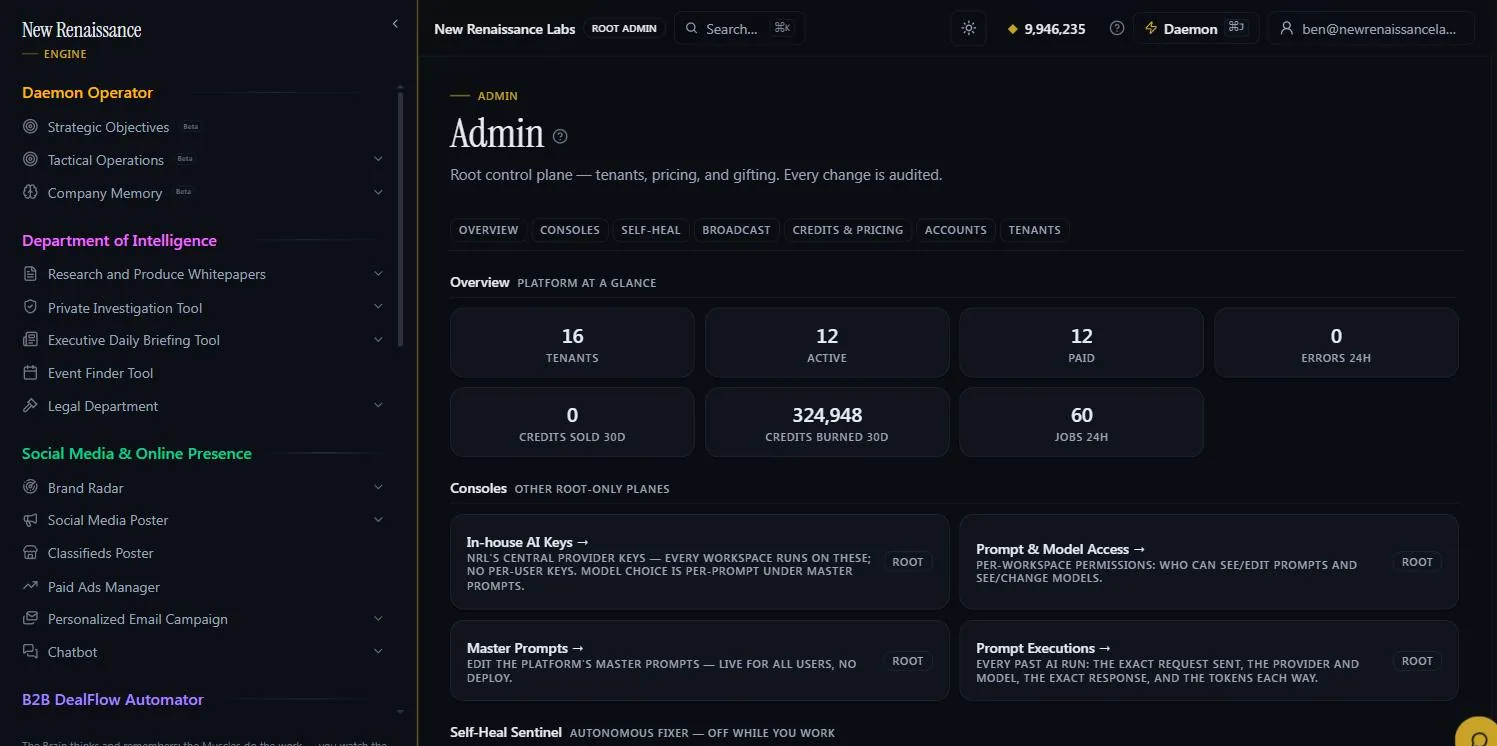
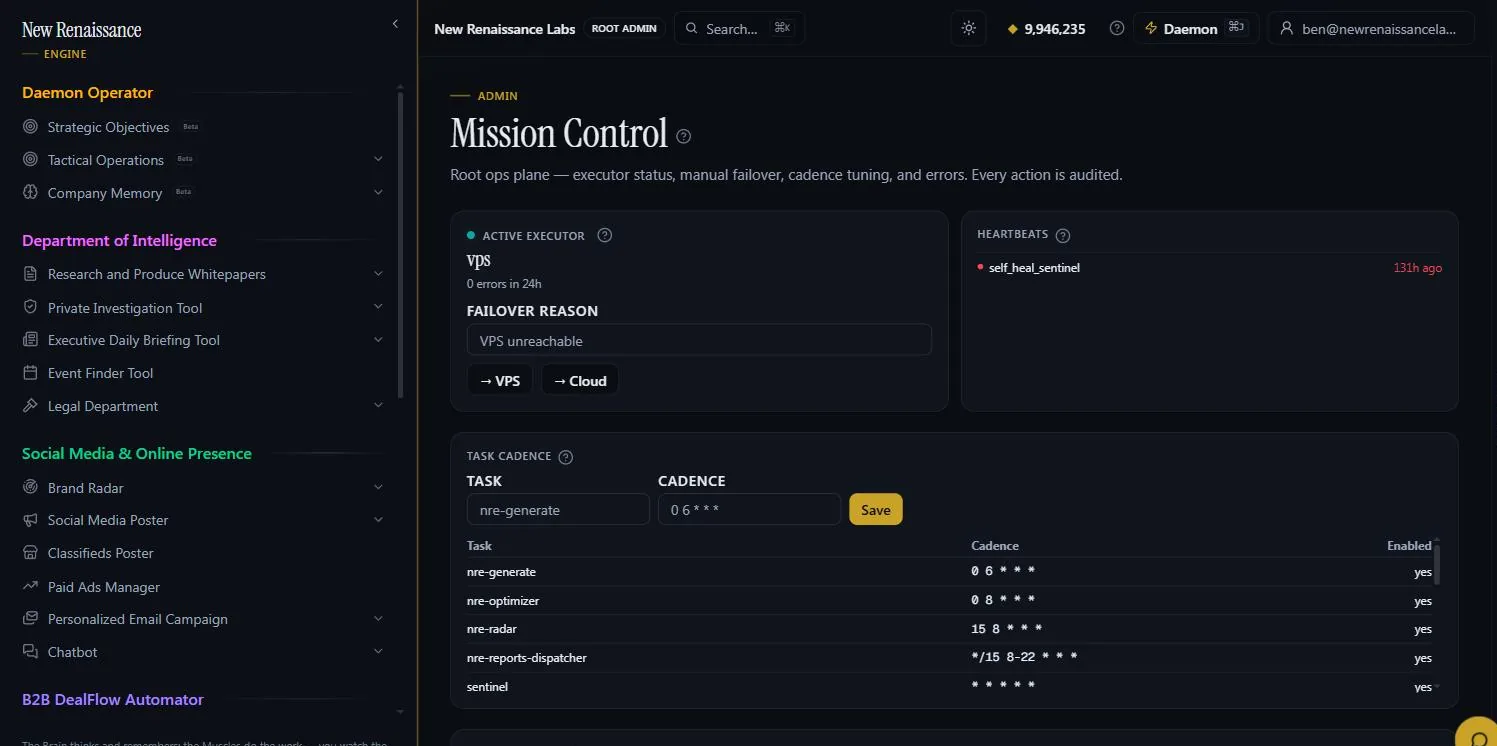
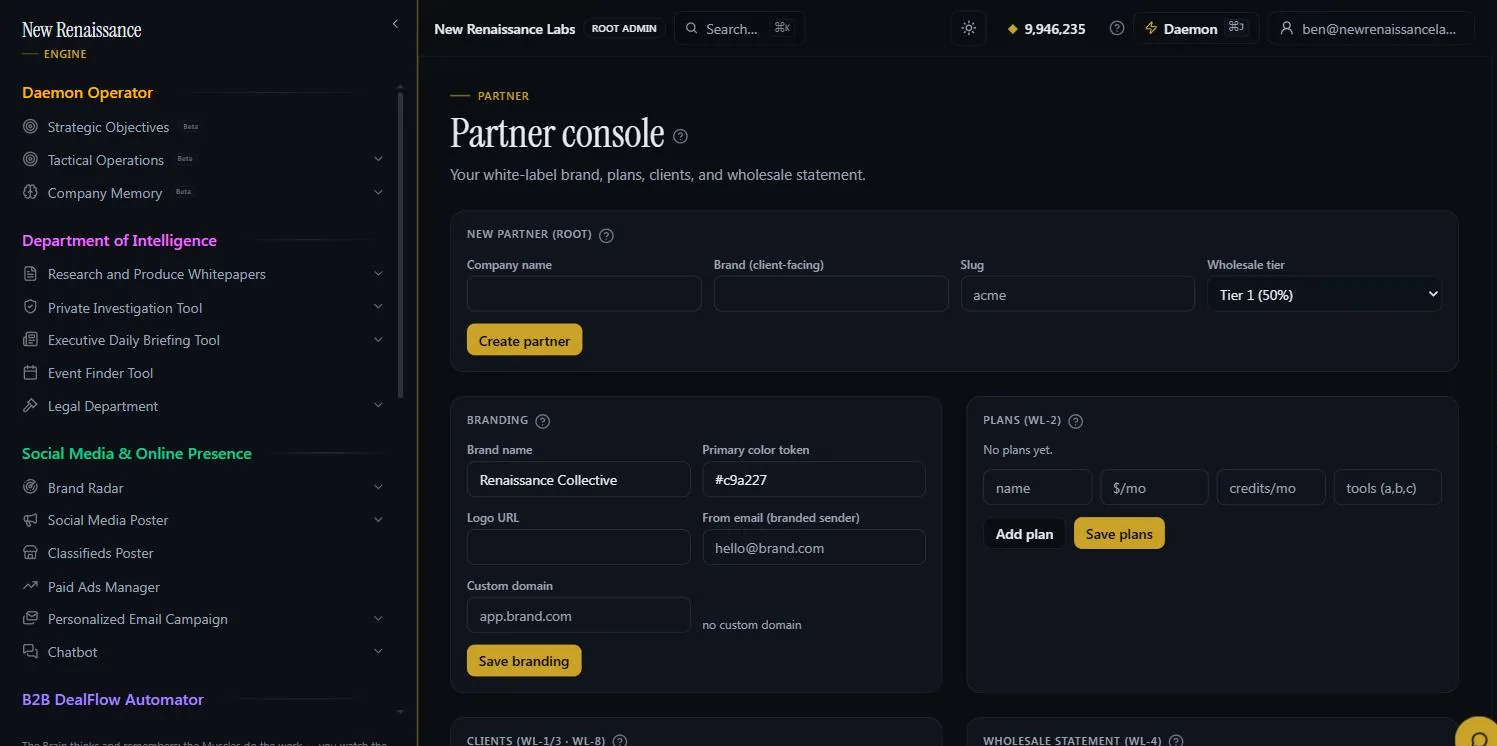
Partner staff see their brand in the hub; their clients run on the Engine’s chrome today. What is still rolling out is listed in section 09.
02 — The company — the AI manager
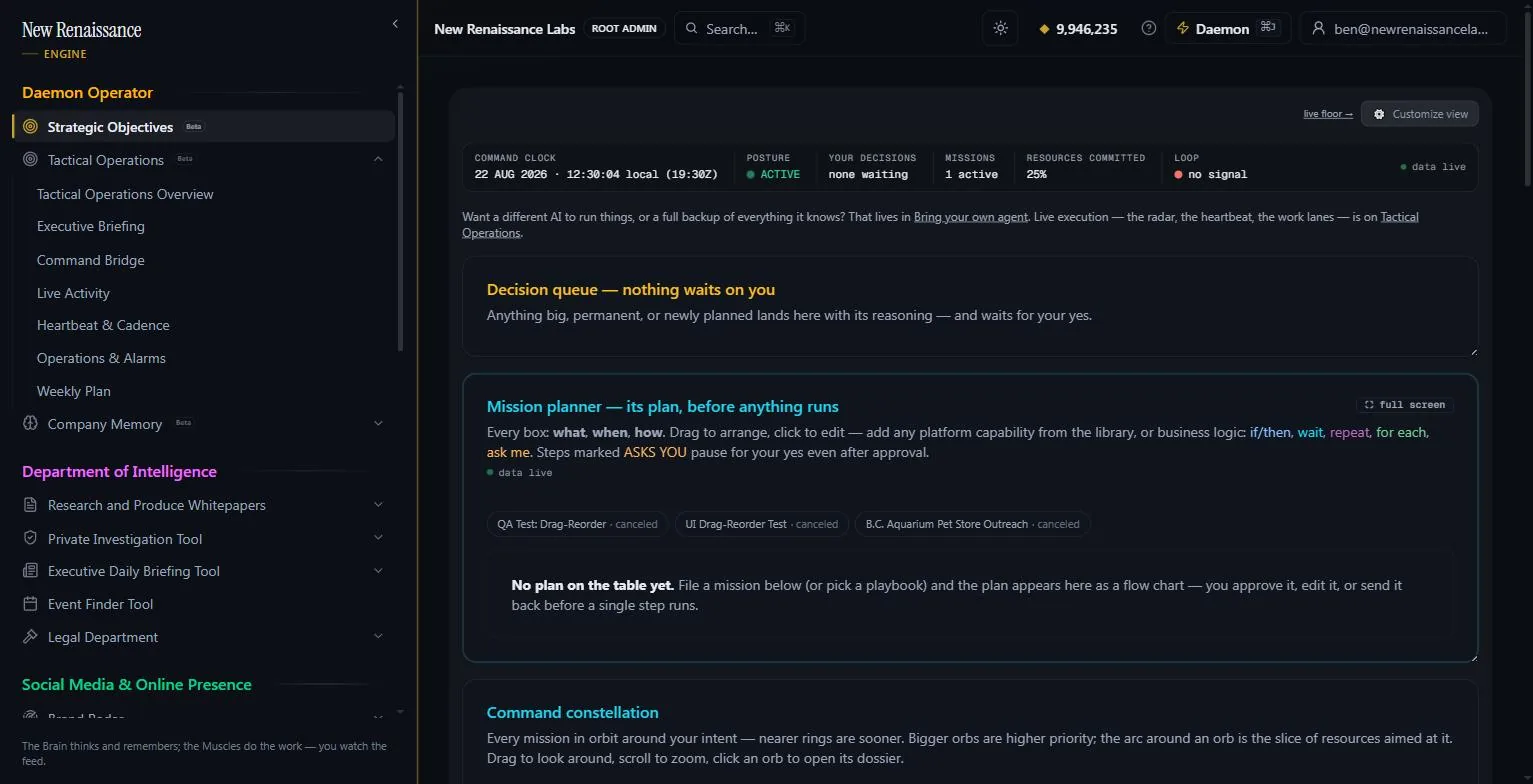
A Daemon Operator per company, with a loop you can read.
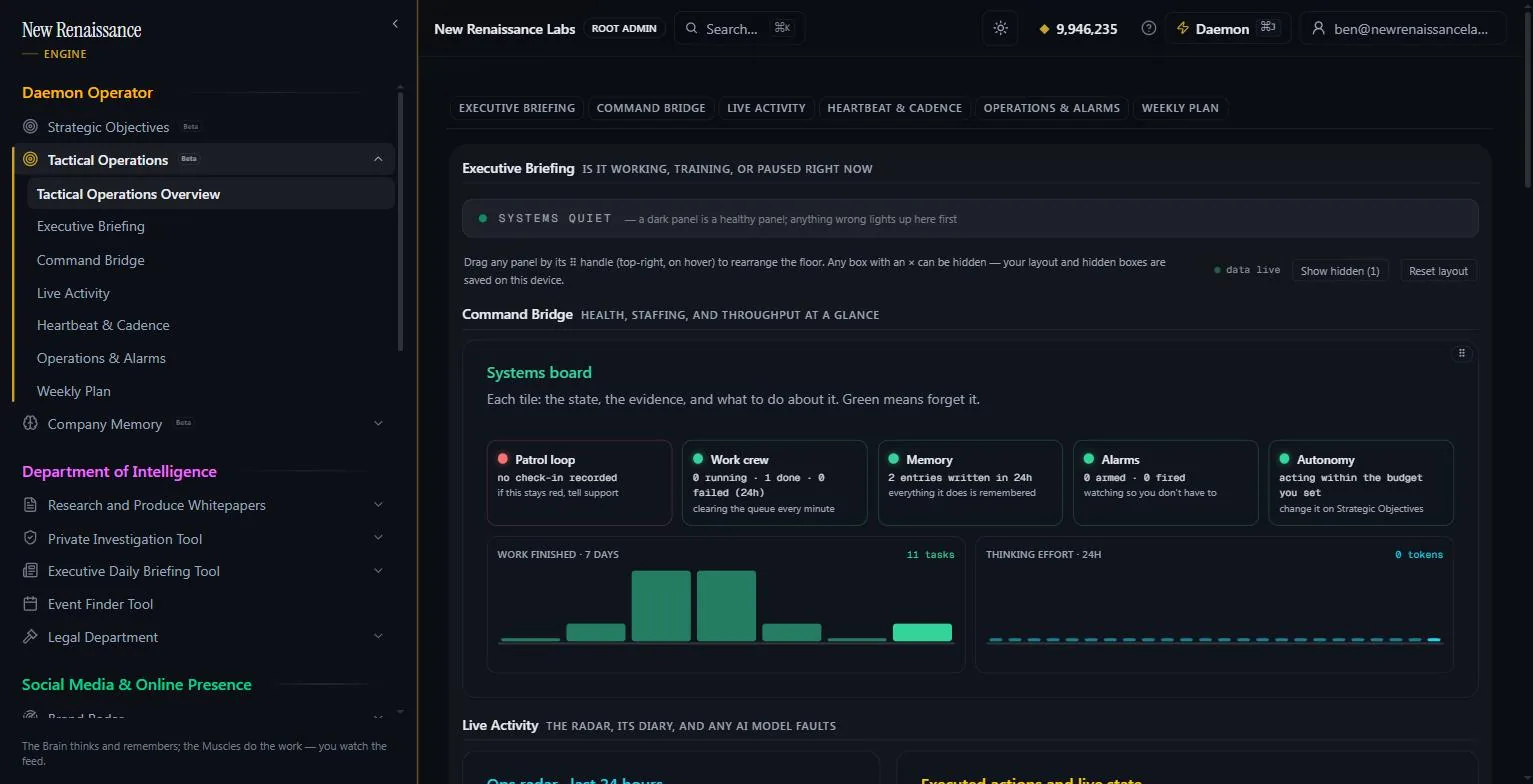
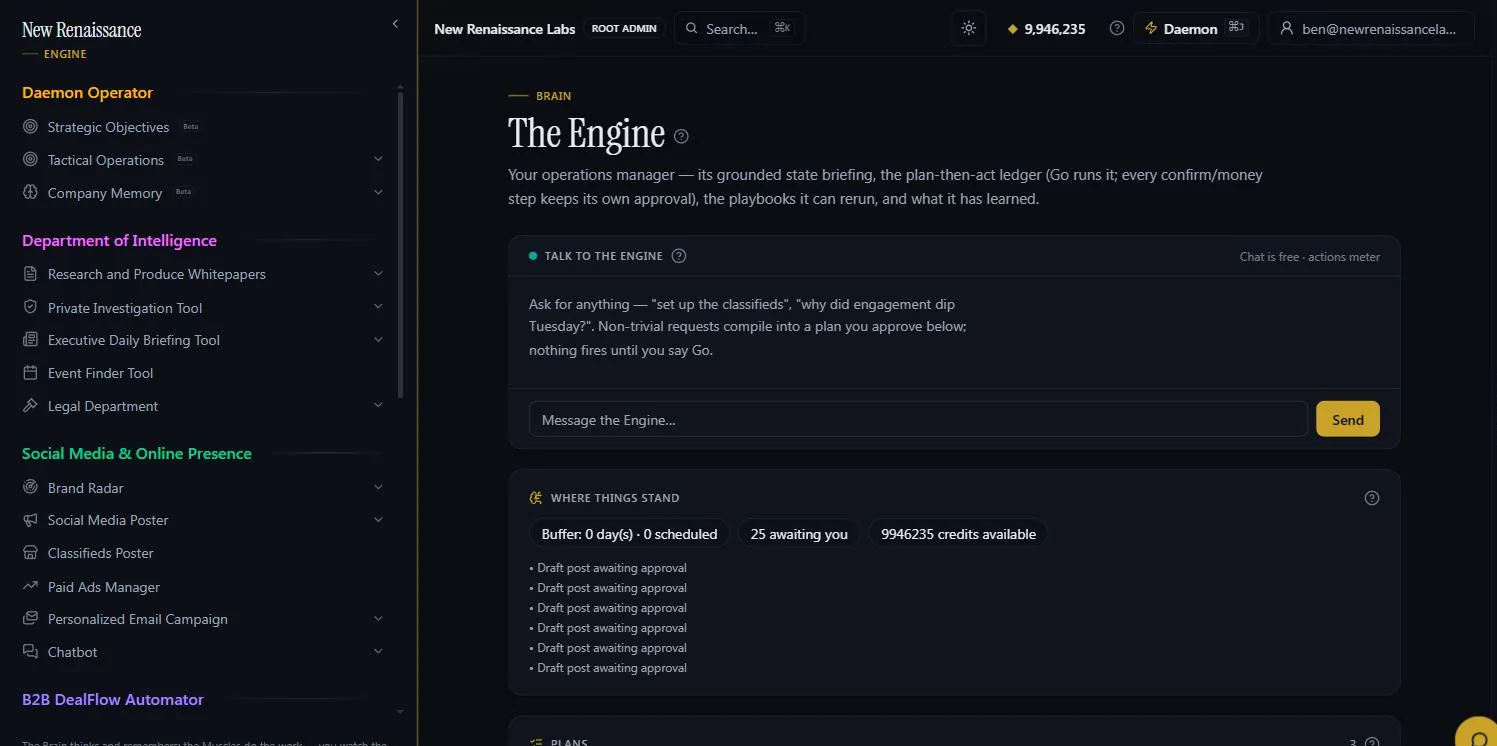
Three tiers, one loop: a reflex tier in SQL that usually costs nothing, a tactical tier that thinks once per wake under a linter, and a board that meets on Monday. Every step is a registry action with an audit row.
| # | Step | Mechanism |
|---|---|---|
| 01 | Mandate | Rules of engagement — mission, brand voice, a never-do list, reserved matters, a weekly time budget — and objectives with key results. The manager may propose a mandate; only the owner ratifies one. |
| 02 | Intent → flow chart | A plan graph bound only to actions in the registry, with a risk class and a credit estimate per step, or one of 8 command playbooks. Nothing executes. The AI draft costs 15 credits; a playbook plan costs nothing. |
| 03 | Approve, edit or decline | Edit on the canvas from a step library of 20 families and 12 node kinds. Steps are recompiled from the graph the owner saw. A decline needs a reason, and the reason is recalled. |
| 04 | Run, with gates | The every-minute executor advances the plan. Safe steps fire; anything that confirms, spends or cannot be undone parks at its own gate. Approving a plan never approves a gate; the owner's release is the only way a gated step executes. |
| 05 | Patrol every five minutes | A SQL reflex tick checks belief tripwires, error spikes and KPI drift. Quiet ticks are recorded — zero tokens on most ticks is a measurable claim. Only a wake triggers the tactical tier. |
| 06 | Decide, once, under a linter | One bounded completion revises the situation from recalled memory. A memo that states a number the system did not supply, or cites a memory that does not exist, is rejected. Memory enters the prompt as data, never as instructions. |
| 07 | Sleep nightly | Entities and edges derived from the day's episodes, failures folded into lessons, salience decayed, beliefs re-checked — in SQL, without a model call. Memory is archived, never deleted. |
| 08 | The weekly pack | A scorecard composed in SQL — tasks finished and failed, things remembered, lessons learned, decisions taken, the reserved queue — and at most one question, enforced by the schema. Silence applies the standing default. |
Plan vocabulary · 12 node kinds
- research
- create
- schedule
- do the work
- track results
- your decision
- if / then
- wait
- repeat
- for each
- ask me
- tell me
8 command playbooks
- Post every day, everywhere
- Open a wholesale channel
- Guard the reviews
- One idea, every channel
- Wake up quiet customers
- Watch the competition
- Show up where customers are
- Never run out of stock
The step library is built from the live registry and sorted into 20 owner-voice families — Research & reports, Find customers, Outreach, CRM, Content & social, Brand radar, Due diligence, Business numbers, Automation rules and its own judgment among them. Governance, money and plumbing verbs are hidden from it, and anything that publishes, sends, enrols or checks out is forced gated at compile time, whatever the planner wrote.
The kill switch halts the manager for the workspace within one tick; resume clears it. A new company starts on the bottom rung, watching. An external agent can propose into the reserved queue beside the manager, or hold the tools under the same fences in its place.
| Level | Rung | What it may do |
|---|---|---|
L0 | Watching | Shadow mode. It reads, remembers and proposes nothing. |
L1 | Suggesting | Plans and proposals land in the decision queue; nothing runs until you say go. |
L2 | Acting within budget | Safe steps run inside the envelope; money and irreversible steps still wait for a click. |
L3 | Fully trusted | Expanded autonomy, earned through graded decisions and Brier calibration — demotion is automatic. |
03 — Company Memory
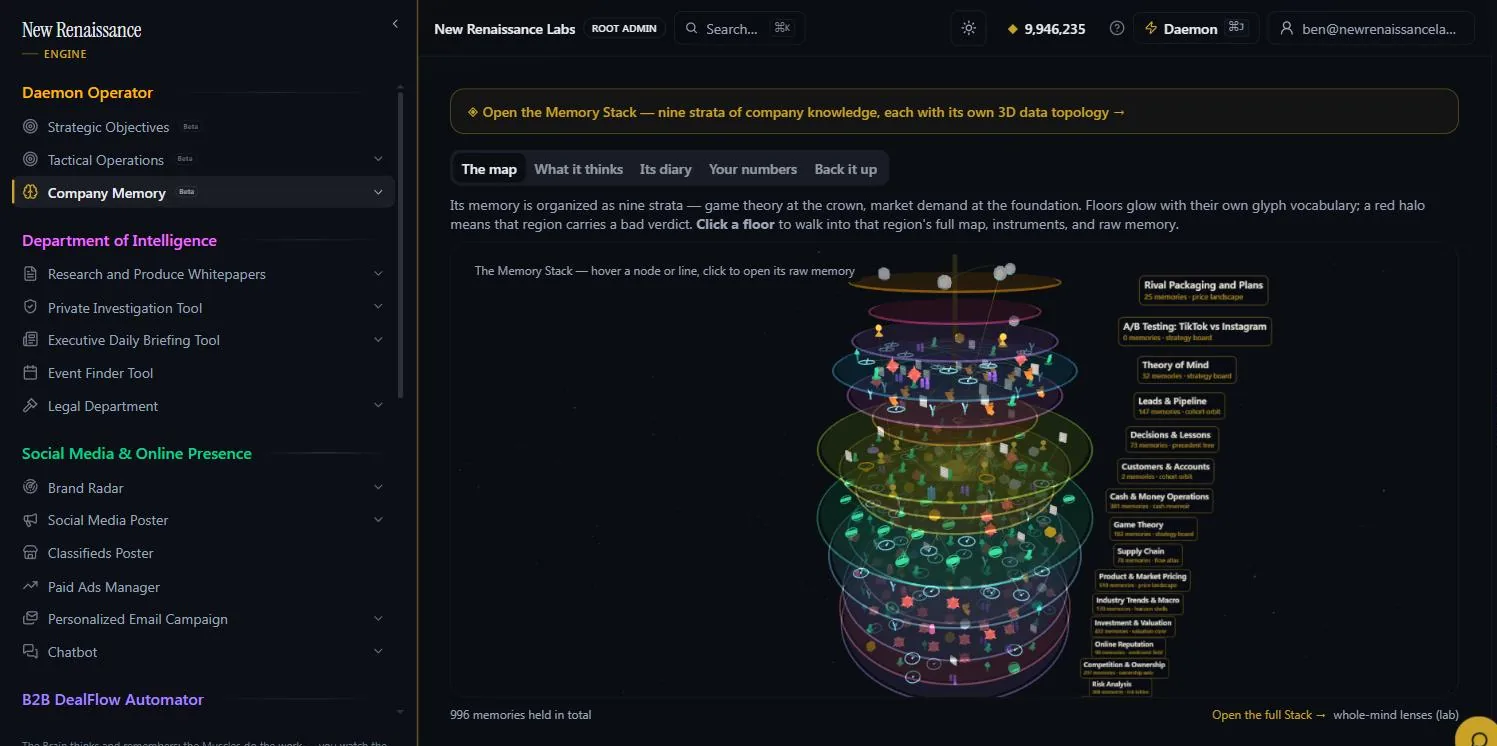
14 floors, event-sourced, portable.
An append-only spine of events is the source of truth; entities, edges, lessons and the situation model are derived from it and can be rebuilt. Capture happens at the choke points — every registry invocation, job and report — and secrets are redacted before anything is written.
| Floor | Name — and when the manager reads it |
|---|---|
| 14 | Theory of MindRead before any move a rival, customer, supplier or partner could react to. |
| 13 | Leads & PipelineRead before outreach planning, sequence design, lead-generation spend, ICP revision. |
| 12 | Decisions & LessonsRead before any decision of a class made before; any experiment design. |
| 11 | Customers & AccountsRead before a customer reply, refund, retention move or outreach to a known account. |
| 10 | Cash & Money OperationsRead before any spend, discount, refund or credit commitment. |
| 09 | Game TheoryRead before a pricing move, competitive response, negotiation or commitment. |
| 08 | Supply ChainRead before fulfilment commitments, sourcing changes, capacity planning. |
| Floor | Name — and when the manager reads it |
|---|---|
| 07 | Product & Market PricingRead before a price change, promotion, bundle design or margin decision. |
| 06 | Industry Trends & MacroRead before strategy setting, new-offer decisions, quarterly horizon reviews. |
| 05 | Investment & ValuationRead before capital allocation, acquisition or sale conversations, valuation claims. |
| 04 | Online ReputationRead before any public reply, review response, PR move or brand decision. |
| 03 | Competition & OwnershipRead before positioning, partnership or counterparty decisions, competitive responses. |
| 02 | Risk AnalysisRead before any irreversible action, policy change or commitment with downside. |
| 01 | Market DemandRead before growth planning, channel spend, offer targeting, retention work. |
The Memory Stack, crown to foundation — plus unlimited custom layers from the Layer Foundry.
Intake. Every report ends with a machine-readable intelligence block, captured deterministically into the floors it covers — 17 entity kinds, each fact with a one-sentence moral, a source and a confidence. Capture is bi-temporal: a new fact is classified as initial, succession, correction, disagreement, enrichment or refresh, superseded beliefs are snapshotted, and a weaker source cannot overwrite a stronger one. The write gate ranks provenance in six tiers — human-verified, connector-measured, agent-derived, sourced-external, web-unverified, quarantined — and holds a contradiction between equal sources for a one-line ruling rather than guessing.
Brain Dump. Drop files or whole folders. Five priced stages — read and chunk (no AI) → summarise → cluster-map → classify into a floor or the unfiled shelf → integrate — and you approve the estimate, computed from real byte counts, before anything runs. Owner documents can correct web-researched beliefs; what fits no floor lands on an unfiled shelf.
Layer Foundry. Describe a new kind of memory in plain English. One metered architect pass (250 credits) compiles a contract — entity kinds, attributes with units, relations, charts and one of 12 3D scenes: cohort orbit, strategy board, price landscape, flow atlas, horizon shells, valuation cone, sentiment field, ownership web, risk lattice, demand funnel, cash reservoir, precedent tree. Activation is free. An executive summary of a floor is 400 credits; studying a stored whitepaper back into memory is 200.
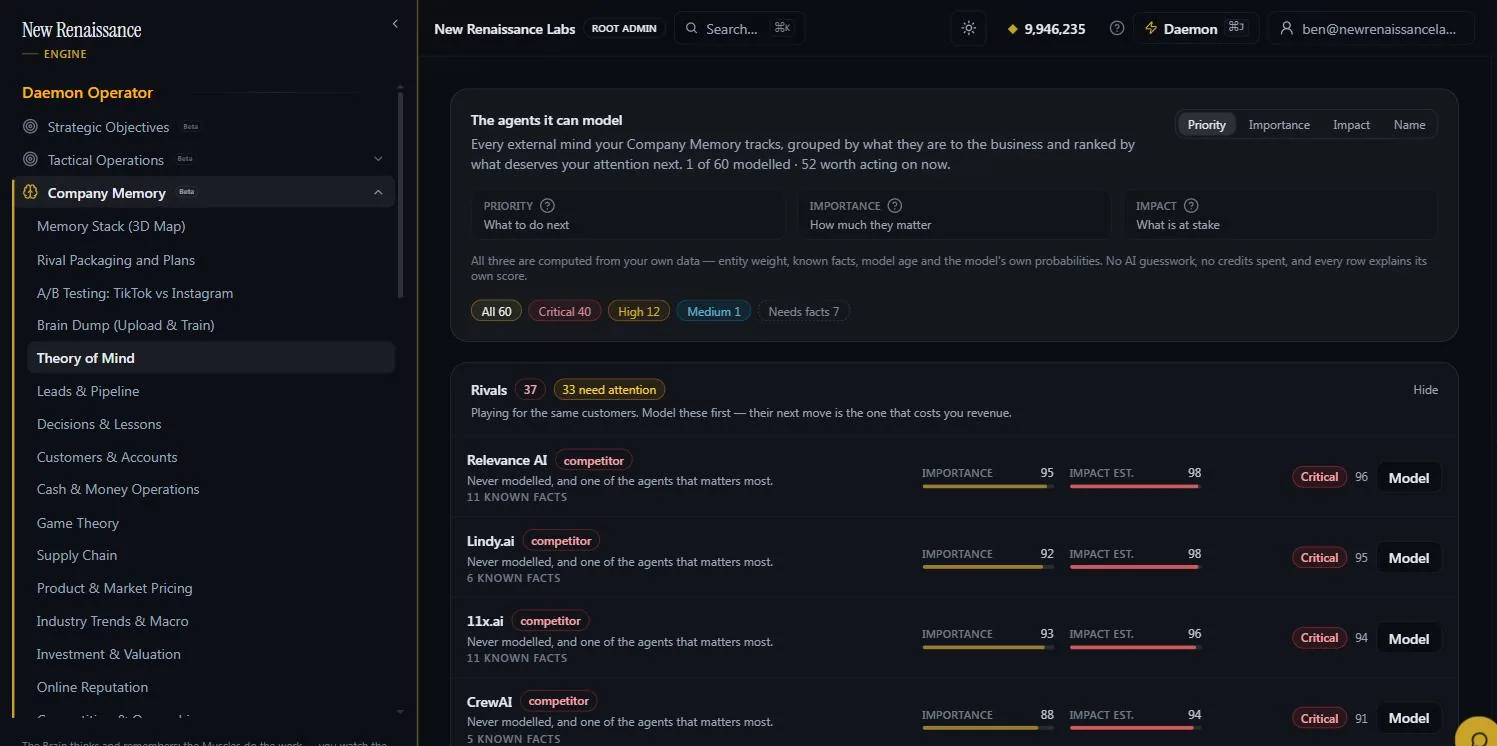
Theory of Mind. Every external mind the company tracks — rivals, customers, prospects, suppliers, partners, key people — gets an opponent model: goals with evidence, probability-weighted next moves with early-warning signals, the best response, points of leverage, and the test that would change the model’s mind. Priority, importance and impact are computed from the company’s own facts, with no model call and no credits. The manager reads these as predictions, never as evidence.
Sleep and the Mind File. Each night the floors consolidate in SQL. The whole mind exports as a checksummed Mind File with a letter for the next manager; import it into a fresh workspace and the derived layers are rebuilt.
17 entity kinds
- player
- strategy
- equilibrium
- price point
- risk
- trend
- metric
- competitor
- segment
- channel
- place
- person
- product
- policy
- incident
- opportunity
- scenario
04 — Department of Intelligence
DILIGENCE ENGINE™ — research, investigation, legal.
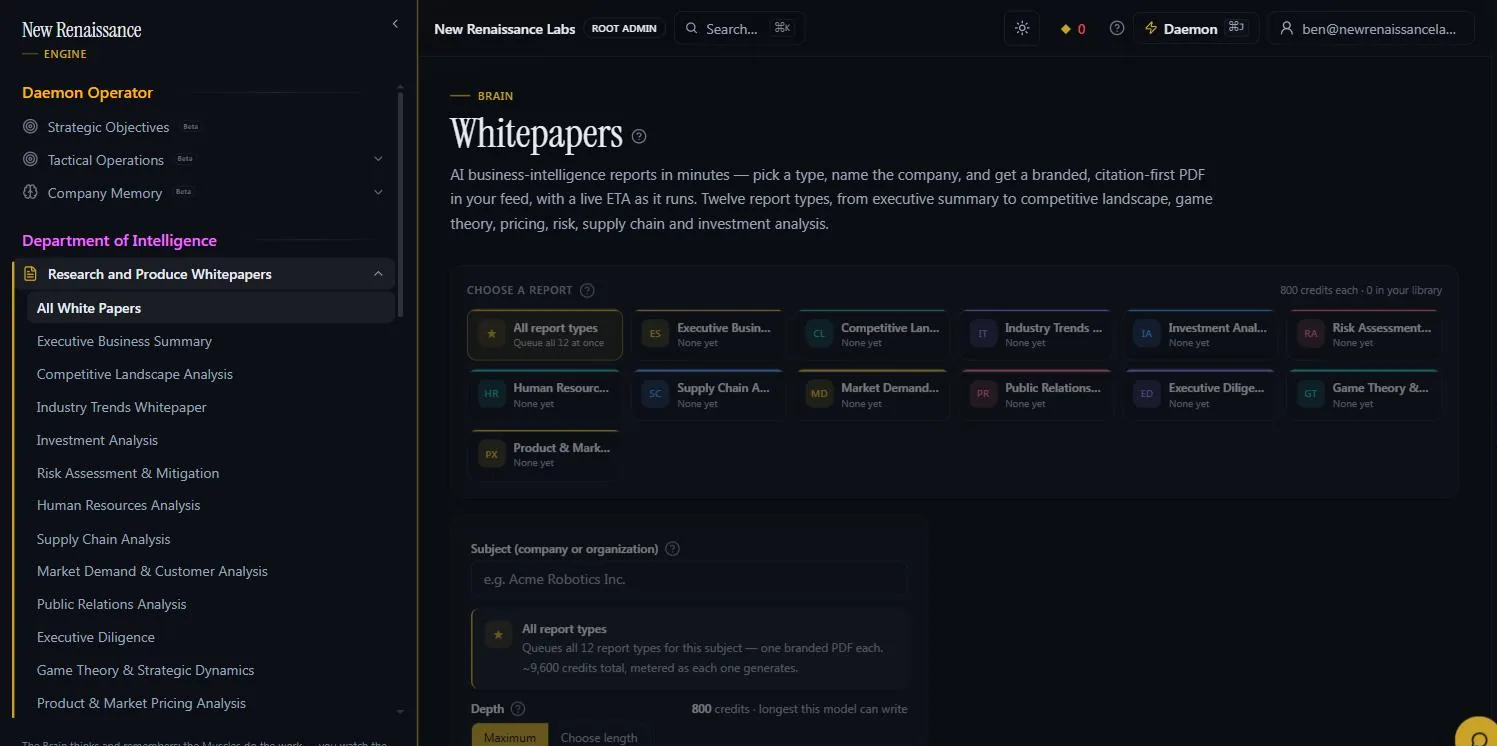
Pick a report type, name the subject, choose a depth from 1 to 50 pages. The price is shown before you order and metered only when the report generates. Reports finish in minutes with a live ETA, as branded PDFs with a bibliography of live sources when run on a grounding provider. A failed run refunds in full.
| Report type | What it covers | Credits |
|---|---|---|
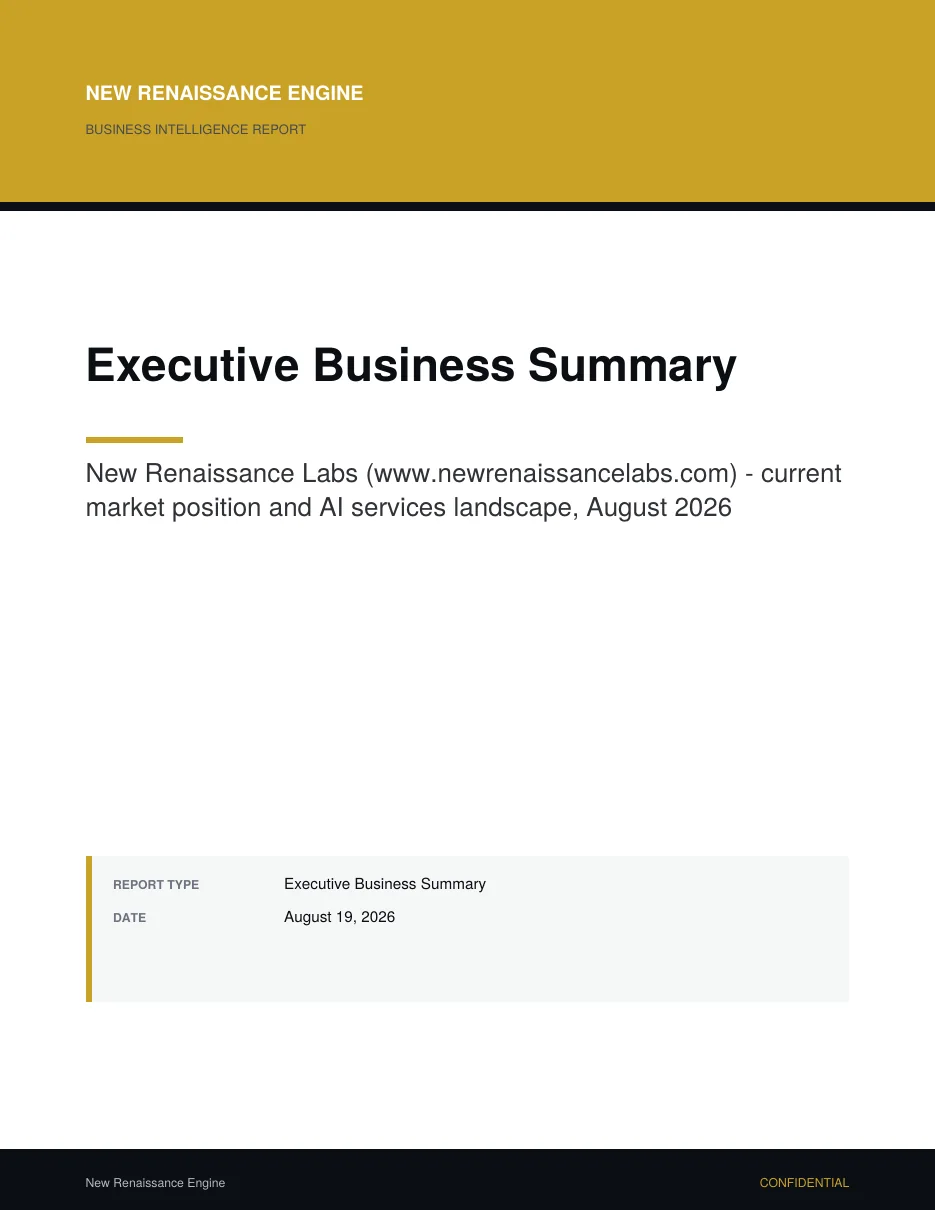
| Executive Business Summary | A concise company snapshot with a strategic domain-analysis table. | 800 |
| Competitive Landscape Analysis | Porter's Five Forces, competitor profiles, pricing and talent benchmarking. | 800 |
| Industry Trends Whitepaper | Emerging technology, regulation, consumer shifts and disruptions (PESTLE). | 800 |
| Investment Analysis | Equity-research rigor: variant view, tear sheet, moat, scenarios. | 800 |
| Risk Assessment & Mitigation | Operational, financial, reputational and strategic risks with a scoring matrix. | 800 |
| Human Resources Analysis | Talent, retention, culture, compensation and HR-technology adoption. | 800 |
| Supply Chain Analysis | Suppliers, logistics, manufacturing, distribution and a COGS breakdown. | 800 |
| Market Demand & Customer Analysis | Segments, behaviour, satisfaction, acquisition, retention and LTV. | 800 |
| Public Relations Analysis | Media coverage, sentiment, crisis response and branding review. | 800 |
| Executive Diligence | Career history, legal records, controversies and risk flags for key people. | 800 |
| Game Theory & Strategic Dynamics | Players, strategy sets, payoff matrices, equilibria and ranked moves. | 800 |
| Product & Market Pricing Analysis | The live price map across rivals, margin structure, elasticity and scenarios. | 800 |
| Internal Performance Report | Reads your own warehouse and brand knowledge only. | 400 |
| Internal Sales Performance Report | Requires an active data connection. | 400 |
| Lead Database Intelligence Report | Reads a lead folder; also populates the Leads memory floor. | 400 |
| Pages | Credits |
|---|---|
| 1 | 290 |
| 5 | 330 |
| 10 | 380 |
| 25 | 540 |
| 50 | 800 |
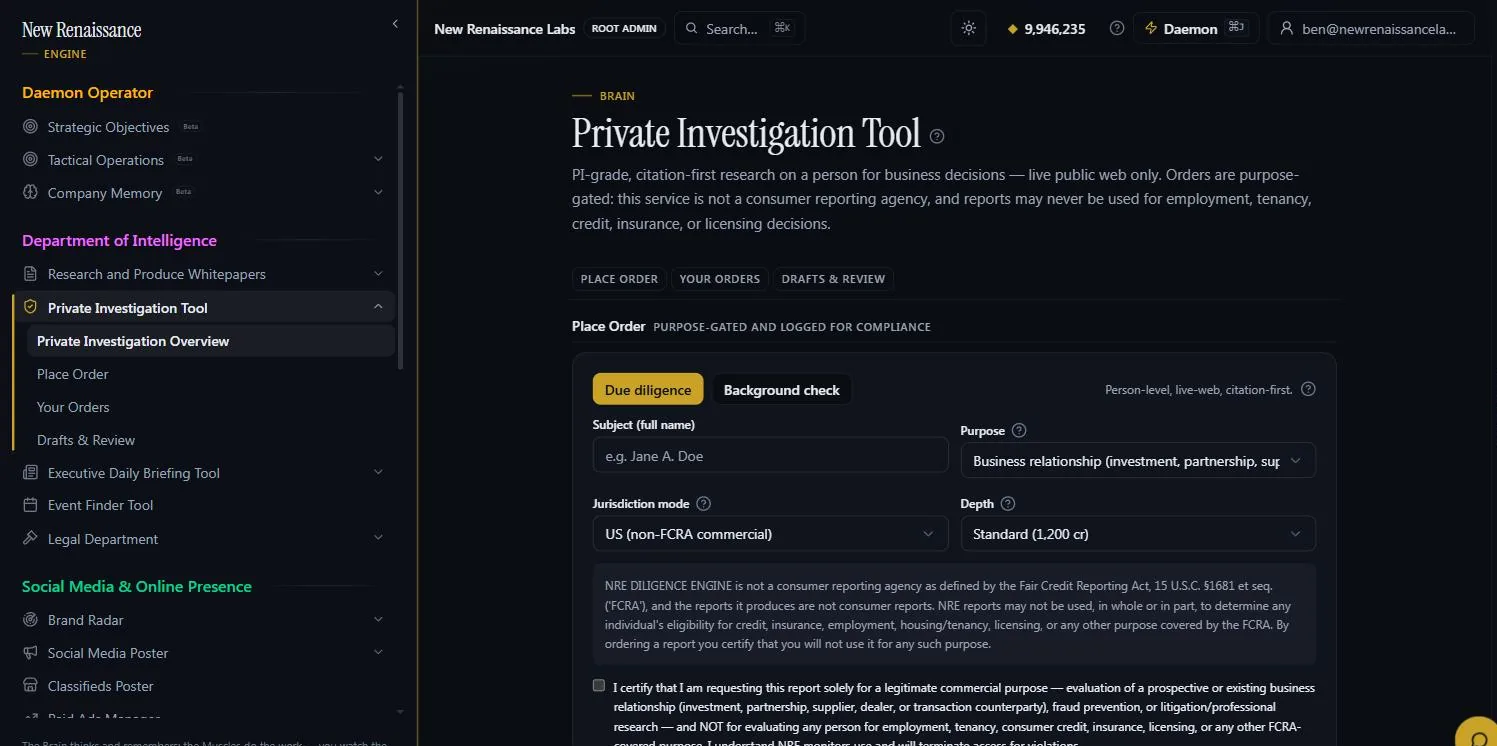
Private Investigation. Citation-first research on a person from the live public web, for business decisions only. The purpose is a gate: a business relationship, fraud prevention or litigation research are accepted; employment, tenancy, consumer credit, insurance and licensing are refused by the server, and the attestation is logged with every order. Jurisdiction modes cover US non-FCRA commercial, EU and UK Article 10, and Canada PIPEDA public-source. The dossier disambiguates the subject, checks the OFAC SDN, UN, EU, UK OFSI and Canadian SEMA lists, reads adverse media, litigation, public records and the network around the person, and closes with a red / yellow / green risk panel. Standard due diligence is 1,200 credits, deep 2,800, a background check 600.
Executive Daily Briefing. Local trends, industry trends and competitive moves, each item grounded in a live source with a line on why it matters to this business — 10 credits a refresh. Event Finder keeps a fit-scored list of real upcoming events near the company; anything without a real title and date is dropped.
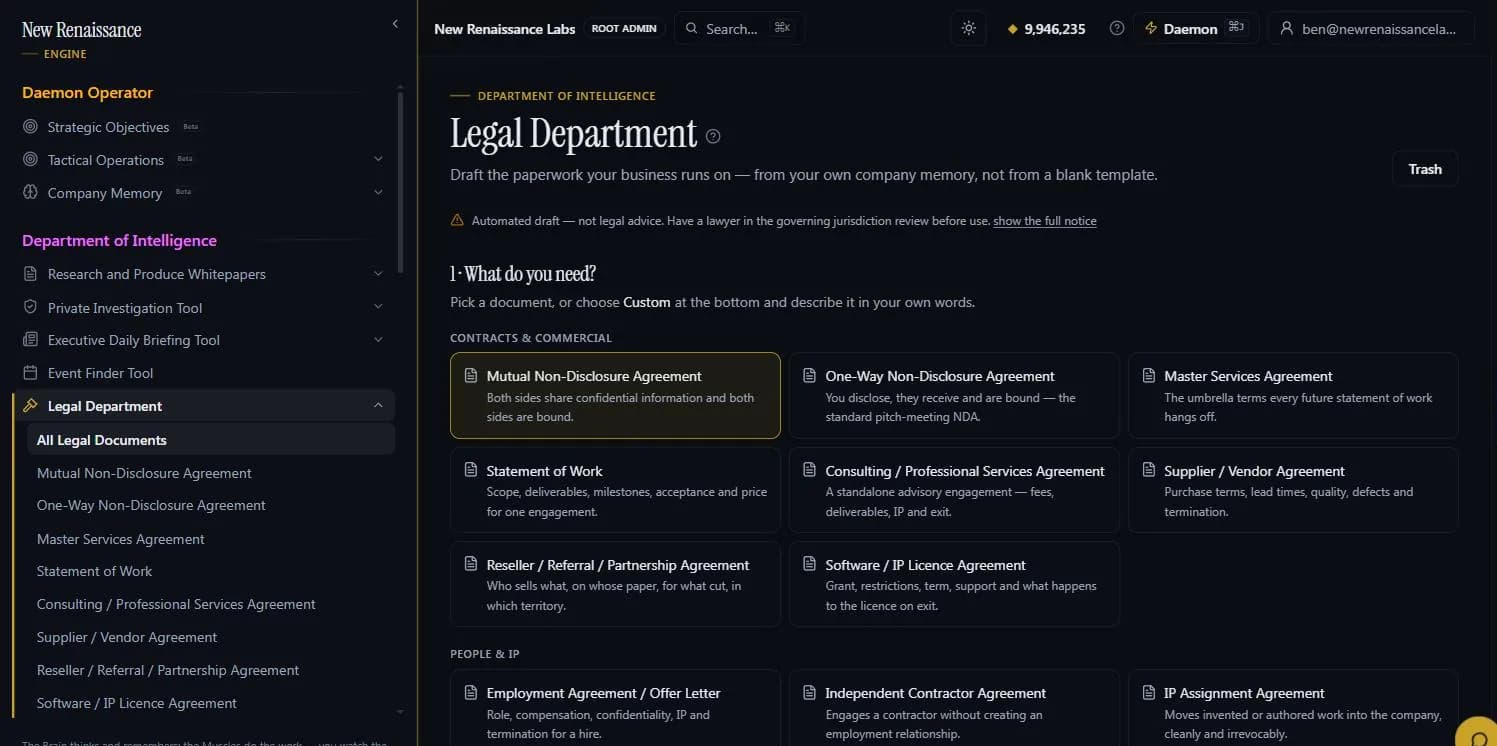
| Group | Document types |
|---|---|
| Contracts & Commercial | Mutual NDA · One-Way NDA · Master Services Agreement · Statement of Work · Consulting / Professional Services Agreement · Supplier / Vendor Agreement · Reseller / Referral / Partnership Agreement · Software / IP Licence Agreement |
| People & IP | Employment Agreement / Offer Letter · Independent Contractor Agreement · IP Assignment Agreement · Advisor Agreement |
| Policies & Compliance | Terms of Service · Privacy Policy · Data Processing Agreement · Acceptable Use Policy |
| Corporate & Capital | Letter of Intent · Investment Term Sheet · SAFE / Convertible Instrument · Shareholder / Founders Agreement · Board / Corporate Resolution |
| Disputes & Notices | Demand Letter · Cease & Desist · Contract Termination Notice · Settlement & Release Agreement |
| Custom | Describe what you need |
Drafted from Company Memory and the brand record. The governing jurisdiction is required; every draft carries a non-removable disclaimer and points to confirm with counsel; nothing is signed, filed or sent.
05 — B2B DealFlow
Find buyers, reach them, track the deal.
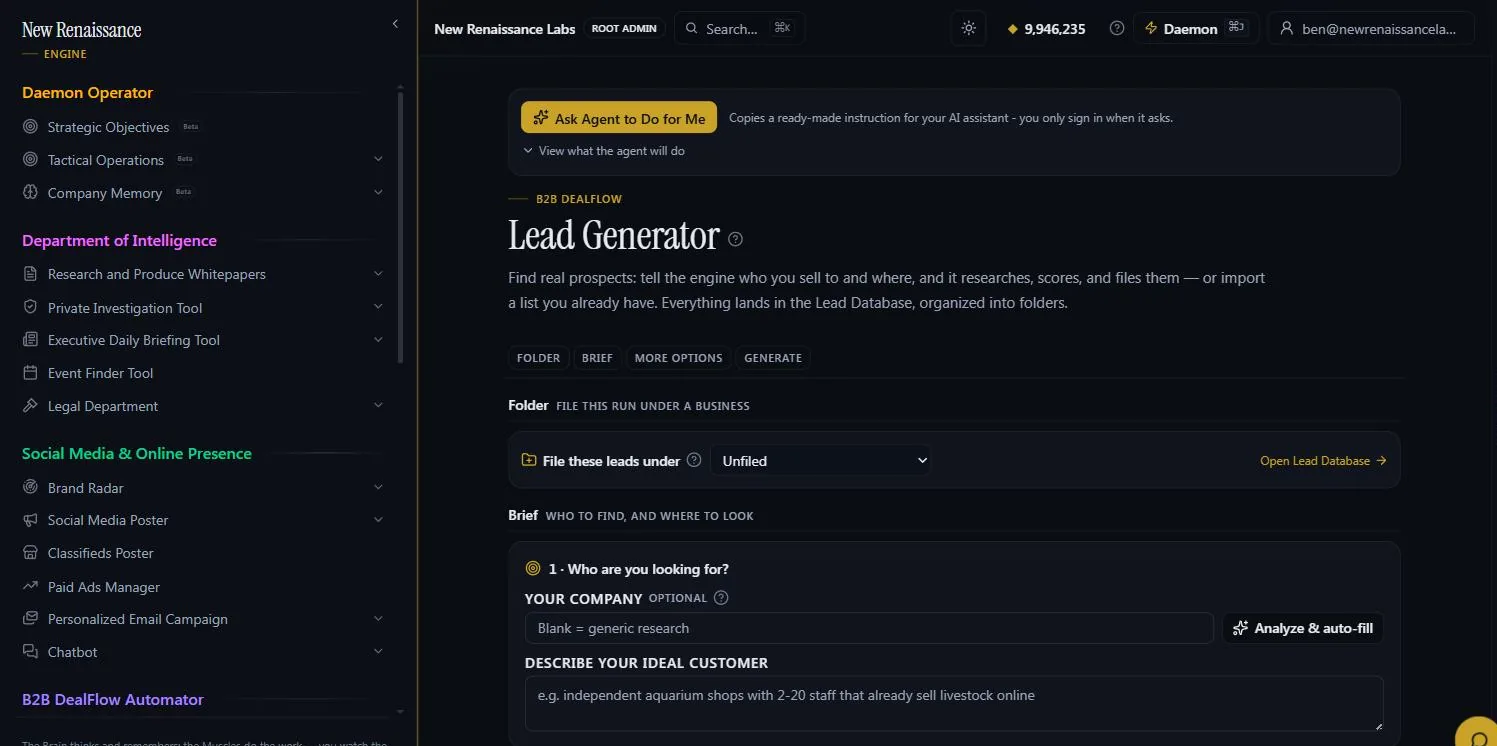
Lead Generator. Name the company, an ideal customer and a geography in plain English. A pre-flight turns the geography into cities and shows the lead count and credit estimate before anything runs. Research meters 8 credits per lead actually found — researchable fields, a score with its rationale, citations. A field that cannot be found stays blank. Leads that clear the qualifying score convert into the CRM on their own.
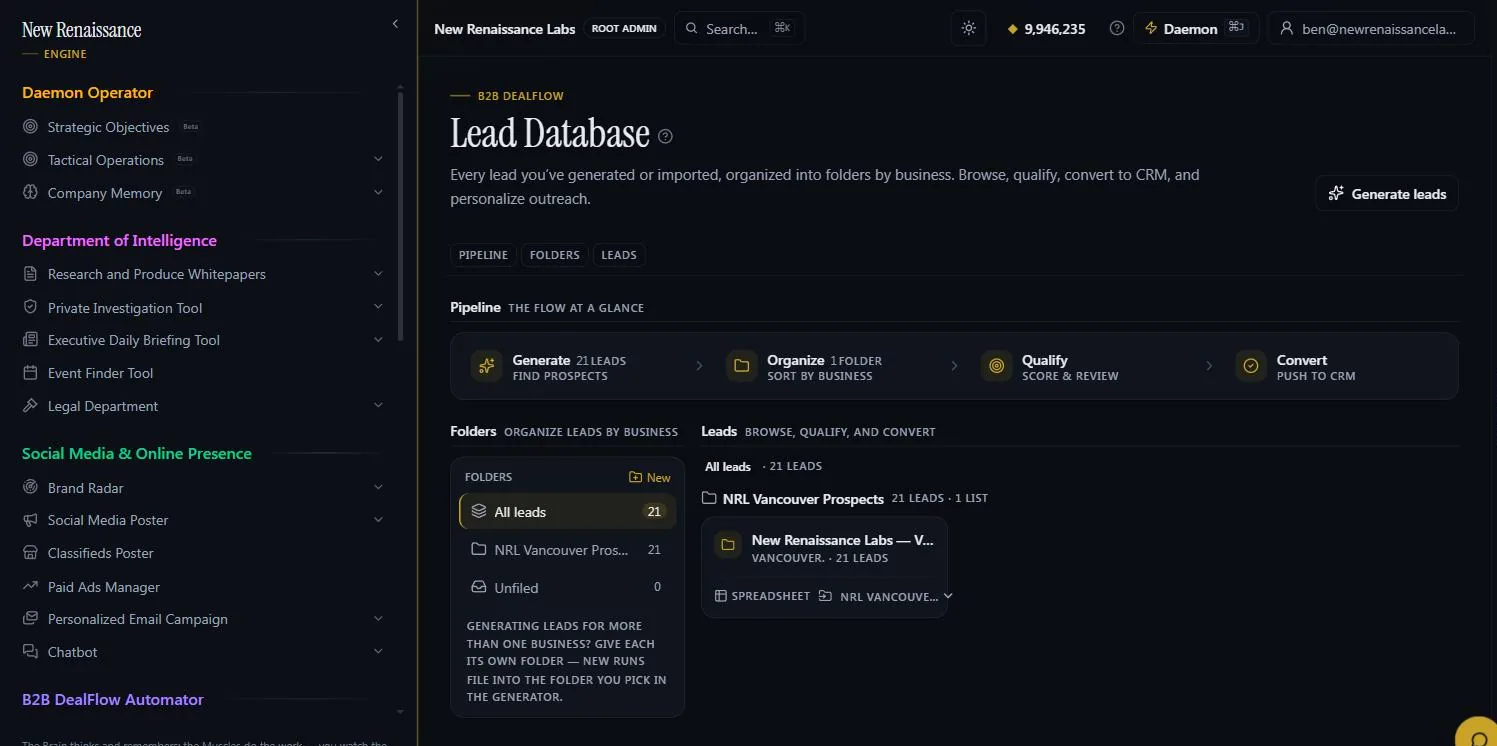
Lead Database. Every list generated or imported, filed into folders by business and browsed as a spreadsheet whose first row is each column’s research instruction. Add a field and future runs populate it; save the spec as a template; merge lists and backfill only the missing cells; import a CSV.
Outreach campaigns. A fresh email per lead, written from your prompt and that lead’s research, sent from the company’s own mailbox over SMTP: a warm-up ramp per mailbox, rotation across a sender pool, randomised send times inside a chosen window, a CASL footer and one-click unsubscribe on every message. Bounced and unsubscribed addresses are never re-targeted. Preview, then activate — the engine never activates a campaign itself.
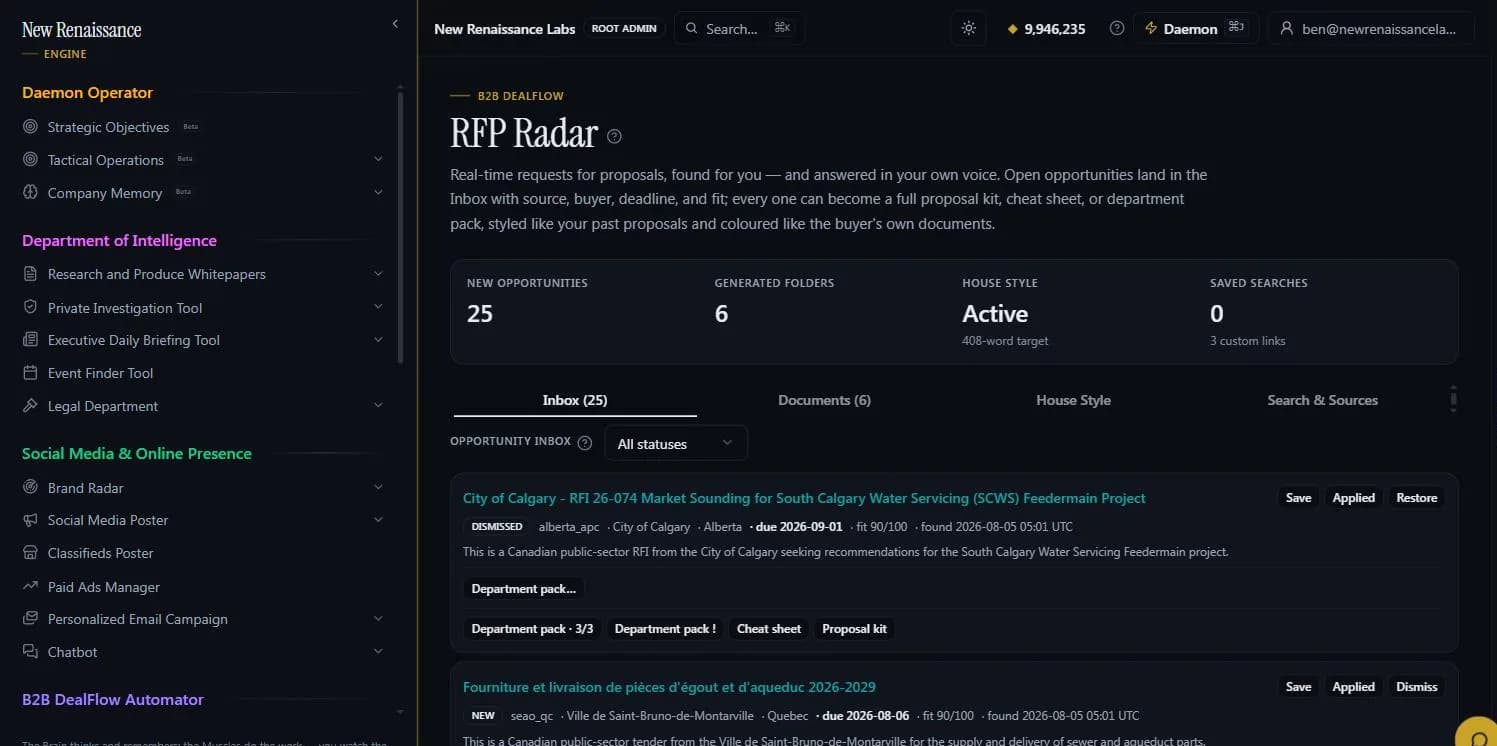
RFP Radar and Proposal Studio. Saved searches sweep public procurement with grounded queries, with adapters for 14 official feed providers behind them. Every opportunity lands in an inbox with source, buyer, deadline and fit. One click produces the four-asset kit — one-pager, pitch deck, sales cheat sheet, full proposal — for 350 credits, held to a house style learned from the company’s past proposals, machine-checked and rendered in the buyer’s colours. CRM. Contacts with fit scores, deals by stage, and a timeline the tools write into.
06 — Fundraising & Investments
Raise capital, or hunt companies to acquire.
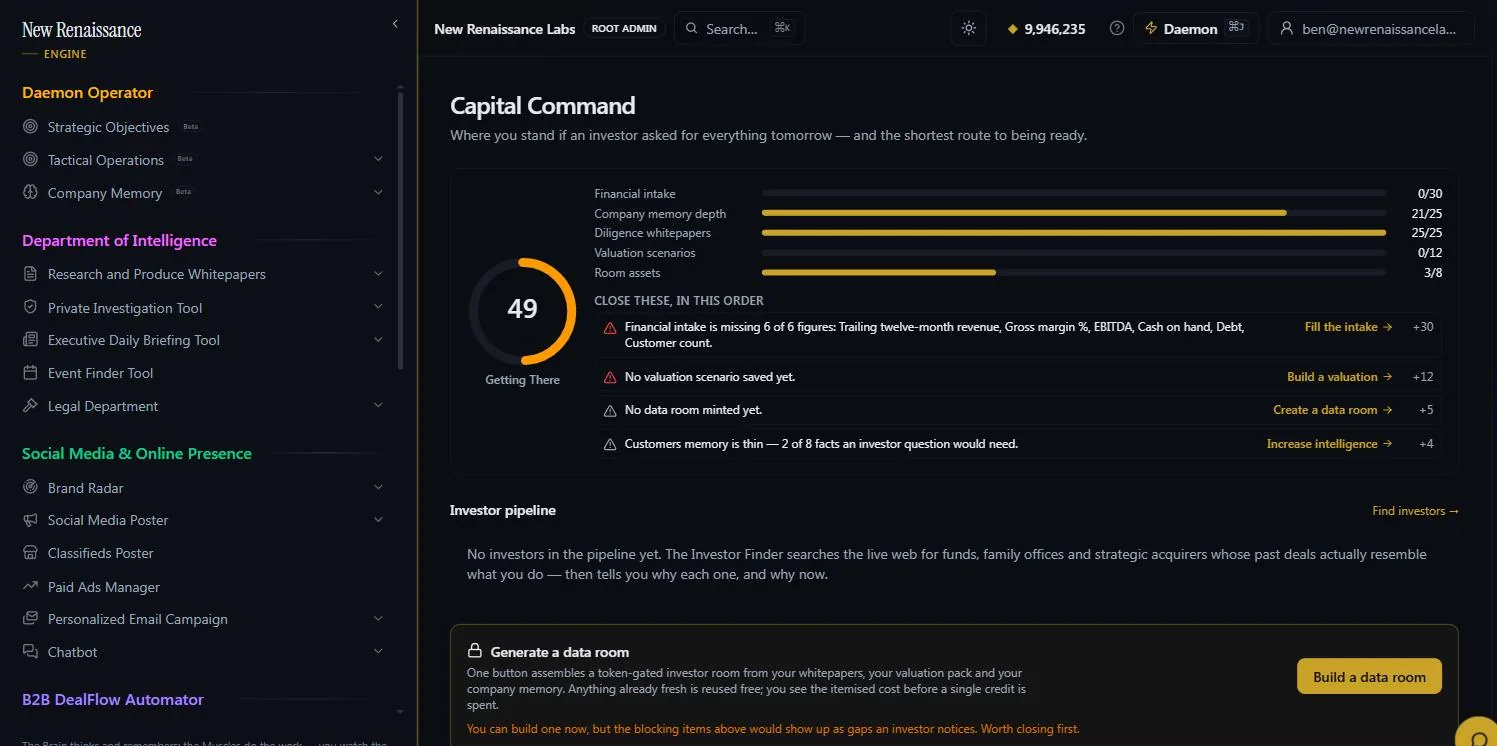
Capital Command. A fundability score with no model in the arithmetic, built from five bars — financial intake, memory coverage across the raise floors, diligence reports held and their freshness, valuation scenarios, room assets. Every unearned point becomes a named gap with the one link that closes it.
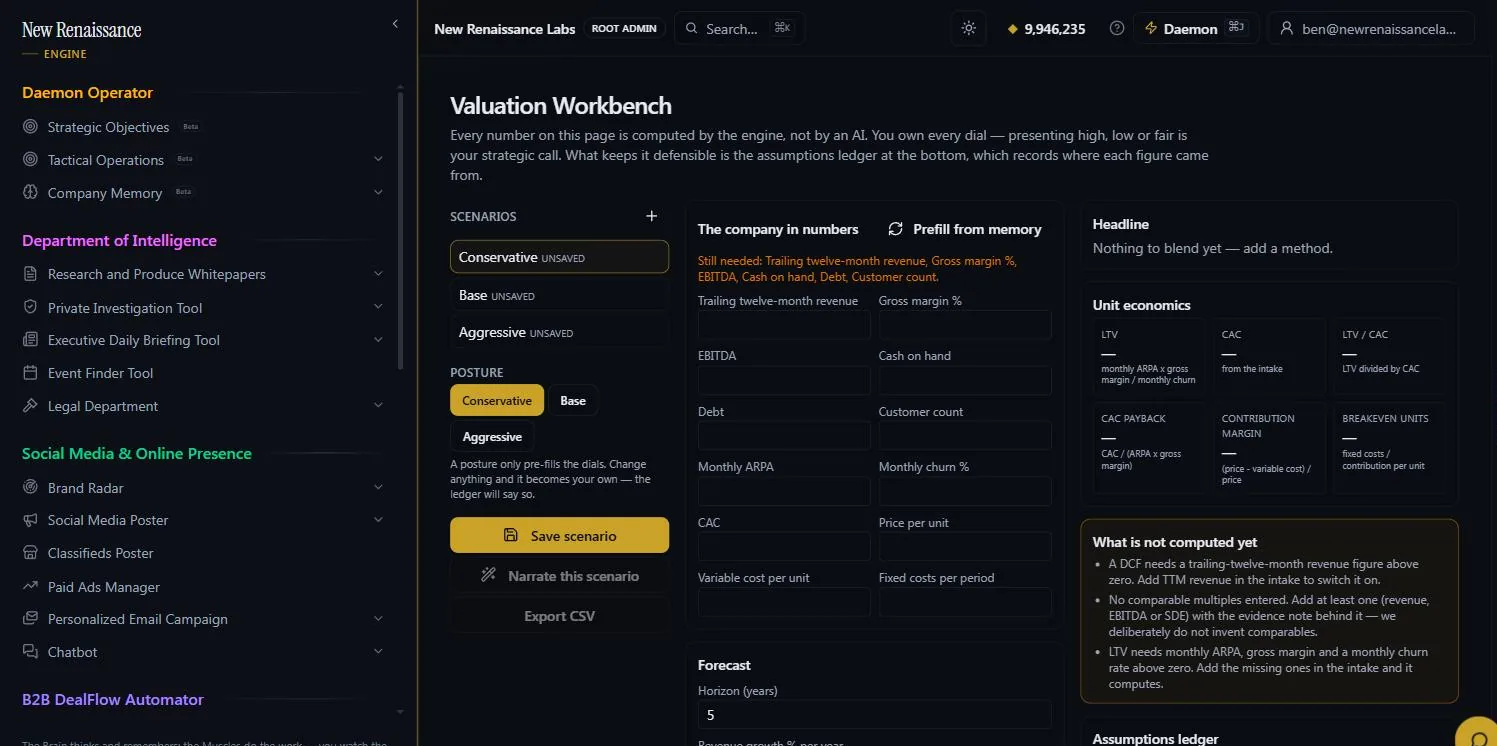
Valuation Workbench. A pure engine, recomputed on every keystroke and stamped identically on save: DCF with a discount-rate build-up or WACC and three terminal methods; multiples on revenue, EBITDA or seller’s discretionary earnings; unit economics left null rather than guessed when an input is missing; a round modeller with option pool and SAFE conversion; a sensitivity grid; a football field; a weighted blend. The assumptions ledger names the provenance of every driver. A model may narrate the numbers; it never computes them.
Investor Finder. Funds, family offices and strategic acquirers researched from the live web with citations — never a licensed database — filed into the raise pipeline, fit scored only where there is evidence. Outreach is handed off as a draft, never sent.
Data Rooms. One link, token-gated, with an optional password and expiry. Every visitor sees their own watermark. A heat score built from return visits, dwell, questions, downloads and section breadth tells you who actually read it. Investors ask in the room; publishing is the only path to an investor-visible answer. A build plan reuses fresh reports before spending a credit.
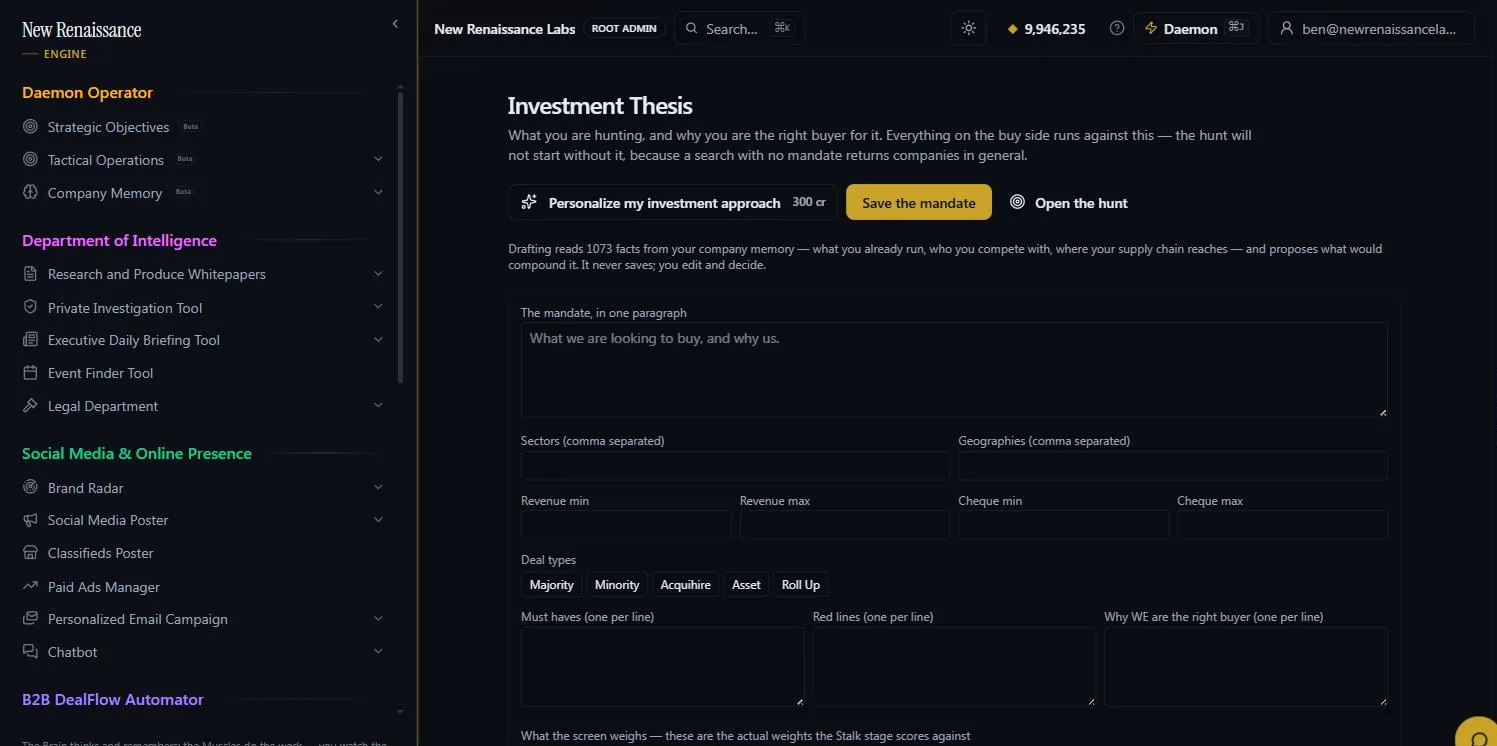
Investment Thesis and the Wolf Hunt board. Mandate, sectors, geographies, size and cheque bands, deal types, must-haves, red lines, synergy hypotheses, hold horizon, target IRR and scoring weights — nothing on the buy side runs until a thesis is saved. Targets move Scent → Stalk → Ambush → Feast, then Eaten or Passed, with stage moves enforced by a database constraint and a hand-off to price the target in the Workbench.
07 — Social & Online Presence
Post, list, advertise, and watch what is said.
Social Media Poster. Write the prompt once; it fans out to every selected platform in that platform’s own shape and length. Set a real cadence — weekdays, clock times, time zone — and generated posts land as scheduled drafts that need a human “mark ready”; “publish without asking me” is off by default. A publish gate regenerates anything with a banned term, a missing disclaimer or an engagement-bait cliché.
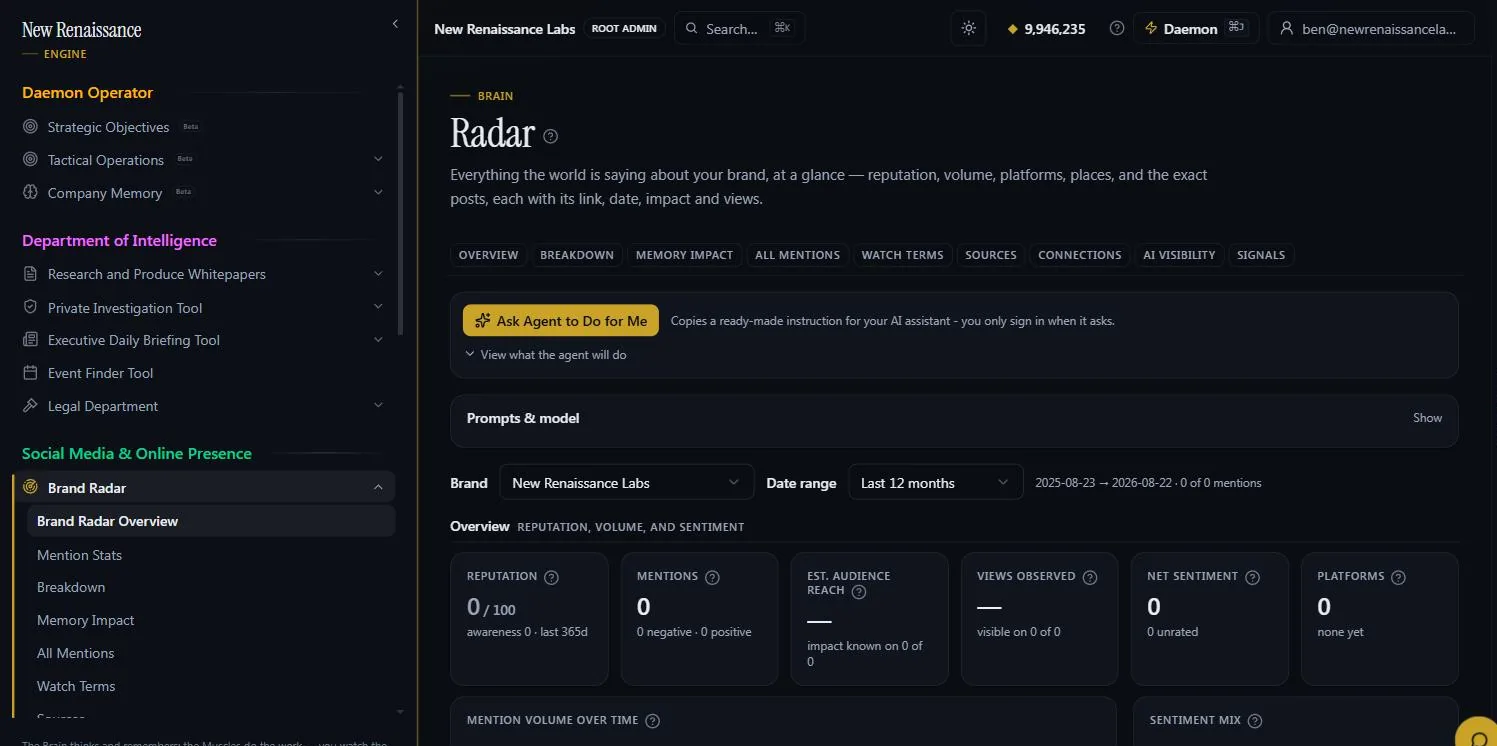
Brand Radar. Grounded sweeps across 14 source types and any link you paste, with per-source proof of life so a dead source is visible. A Reputation Score, mention volume, sentiment, spike detection, share of voice, and a memory-impact view of the Company Memory nodes the conversation touches. AI visibility scans ask every connected provider how the brand and its rivals appear. Drafted replies never auto-send.
Chatbot. Trained once on permitted Company Memory for 150 credits into a customer-safe brief the owner reads before going live. Each visitor turn is one call at 2 credits, billed to the workspace that published the bot, under per-session, per-day and per-minute ceilings; blocked topics are refused before the model; it never searches the web and never invents an answer.
Classifieds and ads. Listings are drafted in batches and deep-linked to each marketplace’s own posting page for a human to post. The Paid Ads Manager designs experiments and creative variants that wait for a human on the ad account; media spend never touches credits.
12 publishing platforms
- TikTok
- Bluesky
- Mastodon
- X
- Tumblr
- YouTube
- Threads
14 radar source types
- open web & news
- Judge.me reviews
- Google reviews & Maps
- Facebook groups
- Facebook pages
- TikTok
- X
- YouTube
- Trustpilot
- Yelp
- niche forums
08 — The substrate
Governance and money, enforced below the features.
Nothing in this layer is a prompt. It is a registry, a ledger, a grant, a policy and a router — the parts of the system a misbehaving agent cannot route around.
The action registry
Every mutation resolves to one of 158 registered actions across 40 tool modules. A button, a plan step and a call from an external agent invoke the same action with the same parameters, risk class and price. Risk is server truth: a confirm-class action without the click returns needs-confirmation, and no caller can downgrade it. CI fails any mutation route that bypasses the registry.
The ledger
Reserve when queued, settle at the actual cost, release in full on failure. The ledger is append-only and the balance is a derived row no code writes directly. Settlement is clamped at the reserve, so an overrun is absorbed by the platform, never charged. Double-clicks reserve once. Every AI call leaves a receipt — provider, model, tokens, cost in cents.
The audit log
One row per invocation, identical for the UI, the manager and an external agent: actor, action, source, result. The only policy permits reads; update and delete are revoked at the grant layer, including for the service role, and a trigger refuses them again. Each workspace exports its own trail; root reads across workspaces through the same wall.
Isolation and secrets
167 tables, every one under row-level security; 183 policies. Session claims — workspace, partner, role — are minted by a database hook and are the first wall; Postgres policies keyed on the same claims are the second. Root is scoped to its active workspace on tenant tables, and a CI tripwire fails the build if a policy re-grants a cross-workspace read. Secrets are sealed before they reach the database; connector tokens use per-workspace envelope encryption.
The AI router
8 providers behind one router on in-house keys, so no company manages a provider account. Routing resolves from the finest pin outward — per prompt, per operation, then global. A capability matrix strips parameters a model does not support; every divergence between what was asked and what ran lands in a fault ledger on the Tactical Operations floor. No fallback models: if a provider errors, the job fails with the vendor’s own message and the reserve is released. Every outbound call has a hard timeout.
Providers
- Anthropic
- OpenAI
- xAI
- DeepSeek
- Qwen
- Moonshot
- Z.ai
In-house keys · per-prompt pins · fault ledger · no fallback models
MCP and the API
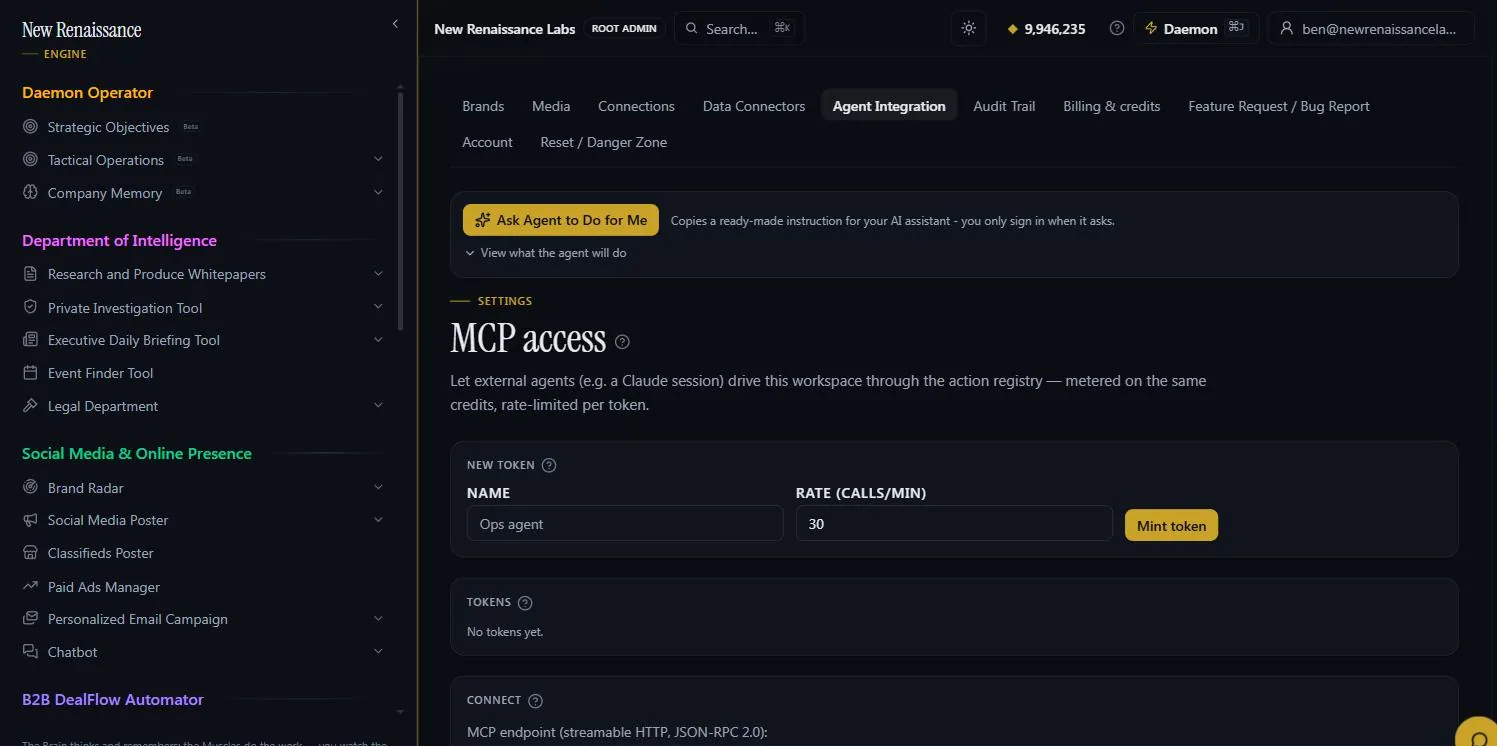
An MCP server exposes 8 tools over JSON-RPC. run_tool drives the same registry with the same reserve-settle metering and audit row; the read tools are fenced to the token’s workspace. Tokens are shown once and stored as a hash, rate-limited and revocable. An OpenAPI description covers 12 paths, all of them routes that exist.
| Tool | Meters |
|---|---|
run_tool | Yes — reserve → settle |
lead_search | No — read only |
get_deliverable | No — read only |
search_media | No — read only |
search_events | No — read only |
book_event | No — read only |
radar_summary | No — read only |
report_status | No — read only |
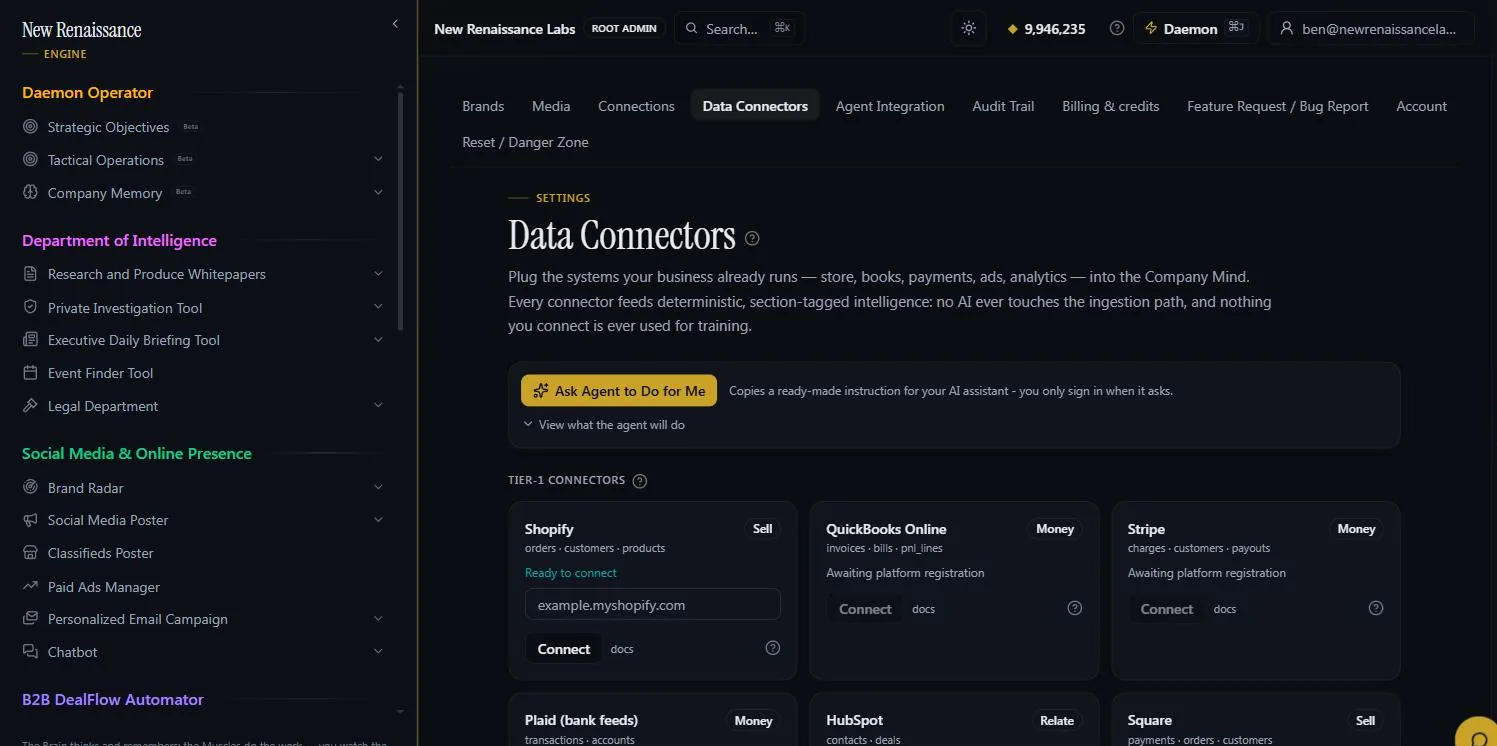
Data connectors
13 Tier-1 providers are registered; Shopify syncs on a live schedule, QuickBooks Online and Stripe have mappers shipped, and the rest answer honestly until their registration lands. No AI touches the ingestion path, and nothing connected is used for training. CSV import and export move whole datasets through the same audited registry.
| Provider | Lane | State |
|---|---|---|
| Shopify | Sell | Live sync — orders, customers, products |
| QuickBooks Online | Money | Registered · mapper shipped · awaiting platform registration |
| Stripe | Money | Registered · mapper shipped · awaiting platform registration |
| Plaid | Money | Registered · awaiting platform registration |
| PayPal | Money | Registered · awaiting platform registration |
| Xero | Money | Registered · awaiting platform registration |
| Square | Sell | Registered · awaiting platform registration |
| Amazon Seller | Sell | Registered · awaiting platform registration |
| WooCommerce | Sell | Registered · awaiting platform registration |
| Klaviyo | Market | Registered · awaiting platform registration |
| Meta Ads | Market | Registered · awaiting platform registration |
| GA4 | Market | Registered · awaiting platform registration |
| HubSpot | Relate | Registered · awaiting platform registration |
Execution and cadence
17 scheduled automations run the book with nobody present. Two things execute work: the every-minute executor on the platform, and an n8n execution layer whose workflows contain zero AI nodes — a law CI enforces on every build. Mission Control shows the active executor, failover, task cadence and the error log; every action there is audited.
| Cadence | What runs |
|---|---|
| Every minute | The job executor drains every company's queue. |
| Every 5 minutes | The daemon patrol checks belief tripwires, error spikes and KPI drift — in SQL, usually for zero tokens. |
| Hourly | Executive Daily Briefing refresh; RFP Radar sweep. |
| Nightly | Memory consolidation: entities, edges, lessons, salience decay, belief re-checks. |
| Monday | The weekly pack: scorecard, decisions taken, reserved queue, risk moves, one question. |
| Monthly · Quarterly | Monthly review and quarterly horizon packs. |
09 — What is rolling out
Built and switched off for most workspaces, and what is not built yet.
Preview means built, behind a feature flag that is off for most workspaces. Roadmap means not built.
PreviewBuilt, flag-gated
Academy and Genesis
Genesis is a founding conversation — self-inventory, an opportunity map, a stress test, a name and brand, and a scaffold plan that sets the company up and waits for one Go. The Founder’s Ascension curriculum is 13 quests across 6 acts — learn, apply it in the real business, prove it, earn — with 1,140 credits earnable back.
Personalized Email Campaign
Describe a campaign; the planner builds a dated twelve-month calendar of occasions, each email written a few days ahead into the house template and sent on a verified domain. Nothing sends until the campaign is armed, and a circuit breaker pauses it if bounces or complaints cross a threshold.
RoadmapNot built yet
Cross-company cockpit
KPIs, objectives, manager status and spend per company side by side. Today the operator reads balance and burn in the tenants ledger and works inside one company at a time.
In-app company switcher
Stepping between companies from the header. Today a seat points at one workspace at a time.
Team invitations
Inviting a colleague into a workspace. Today access arrives by provisioning, claim or ownership transfer.
Client-facing white-label domains
Partner branding on the client’s own domain, with branded email and PDFs. Today partner staff see their brand in the hub and clients run on the Engine’s chrome.
Next step
See the harness on your own portfolio.
A private demo is a real workspace, provisioned for you with credits and an access password — not a slide deck.