White-label & partner programme · Accounting & CFO advisory
Fundability, valuation and the ledgers — computed, not guessed.
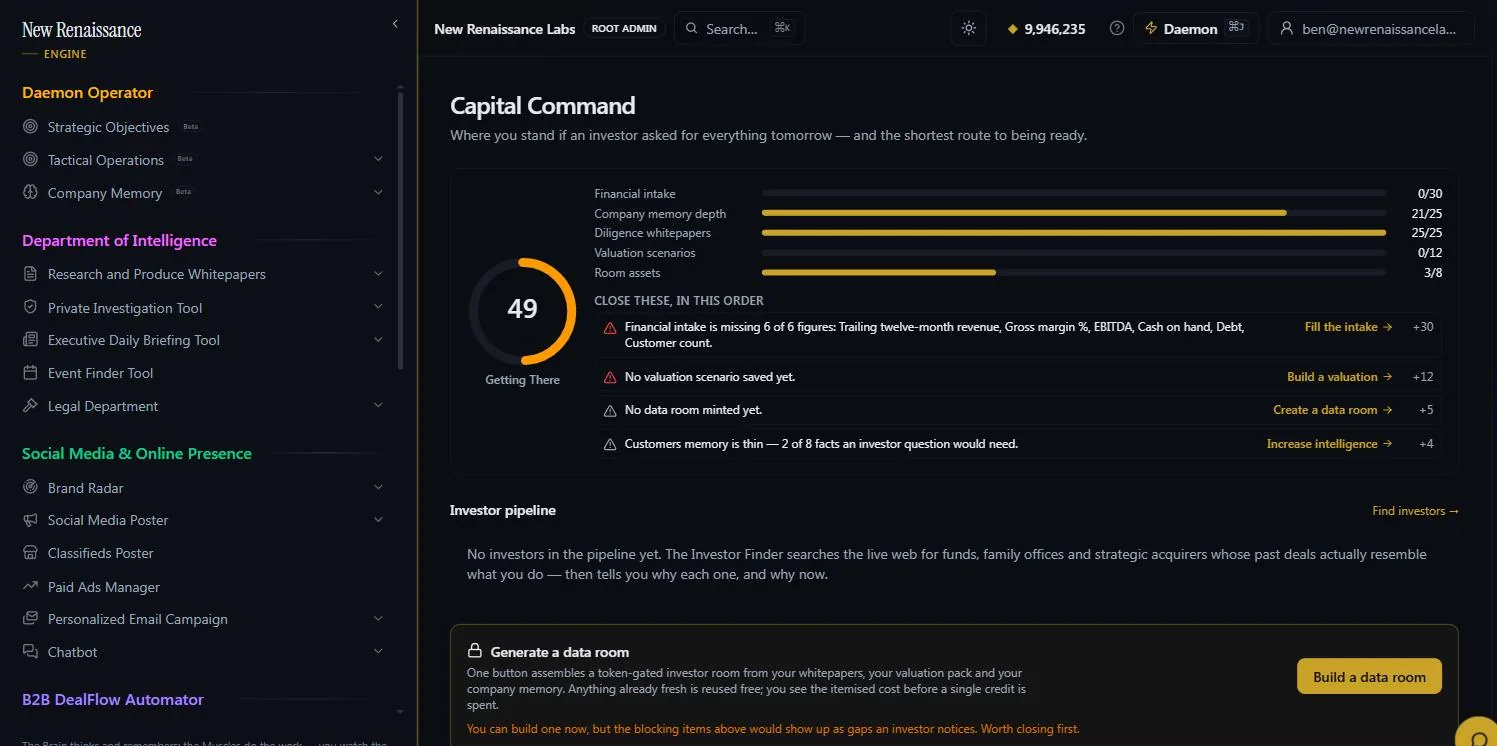
The capital wing of the harness is built for the firm that keeps the numbers: a readiness score with five bars, a valuation engine that computes every figure deterministically and records every assumption, data rooms that tell you who read what, connectors into the client’s systems, and a credit ledger your staff can reconcile line by line. Under your brand, at wholesale.
01 — What you resell or run
The numbers layer, one workspace per client.
Each client gets a workspace under the firm’s row, provisioned from a template with starter credits. Inside it, the Fundraising & Investments wing holds Capital Command, the Valuation Workbench, Investor Finder and Data Rooms; the Department of Intelligence holds the internal reports that read the client’s own data; Settings holds the connectors and the billing panel. The wing is enabled per workspace by our operator, and the money laws hold in all of it: price before run, reserve then settle then release, overruns absorbed by the platform.
Capital Command
LiveA fundability score from five bars, computed by the engine with no model involved: financial intake, memory coverage, report freshness, valuation scenarios and room assets. Every gap carries a link to the page that closes it and the points it is worth.
Valuation Workbench
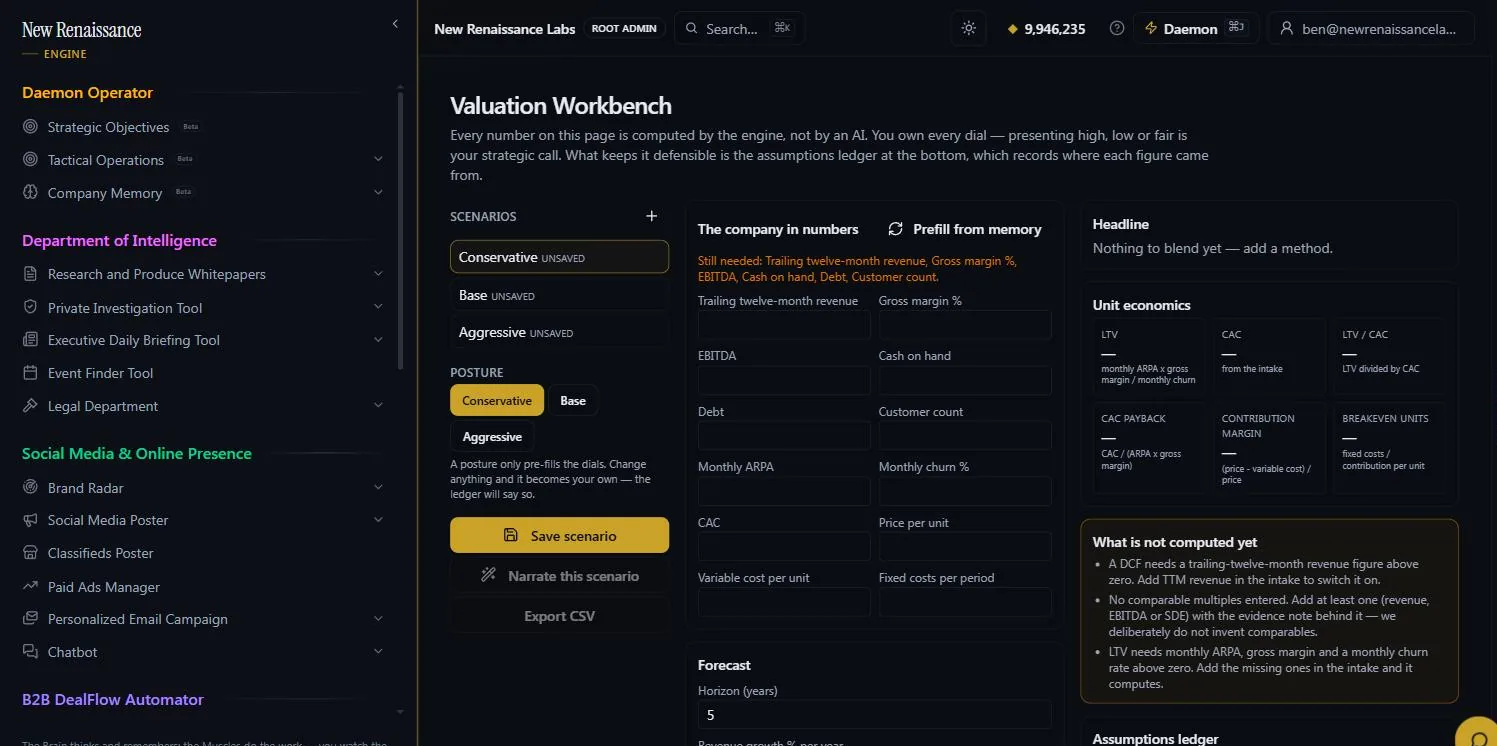
LiveDCF, multiples, unit economics, round and SAFE modelling, sensitivity, a football field and a blend, with an assumptions ledger that records where every driver came from. The engine computes; a model only narrates the engine's outputs.
Data Rooms
LiveOne token-gated link per raise or sale, with an optional password and expiry, a per-visitor watermark, a question queue, and an engagement heat score from return visits, dwell, questions and downloads. A fresh finished report is reused before a credit is spent.
Data connectors
Live13 Tier-1 providers registered: Shopify sync is live, QuickBooks Online and Stripe have mappers built, and the rest — Plaid, PayPal, Xero, Square, Amazon Seller, WooCommerce, Klaviyo, Meta Ads, GA4, HubSpot — await platform credentials. Ingest runs with no model in the path, and a CSV can be uploaded to the warehouse directly.
Internal reports from the client's own data
LiveThe Internal Sales Performance Report at 400 credits reads a connected source: revenue and order trend, average order value, best- and worst-priced products, cohorts and repeat rate. No web research; every figure from the data.
The credit ledger, in the open
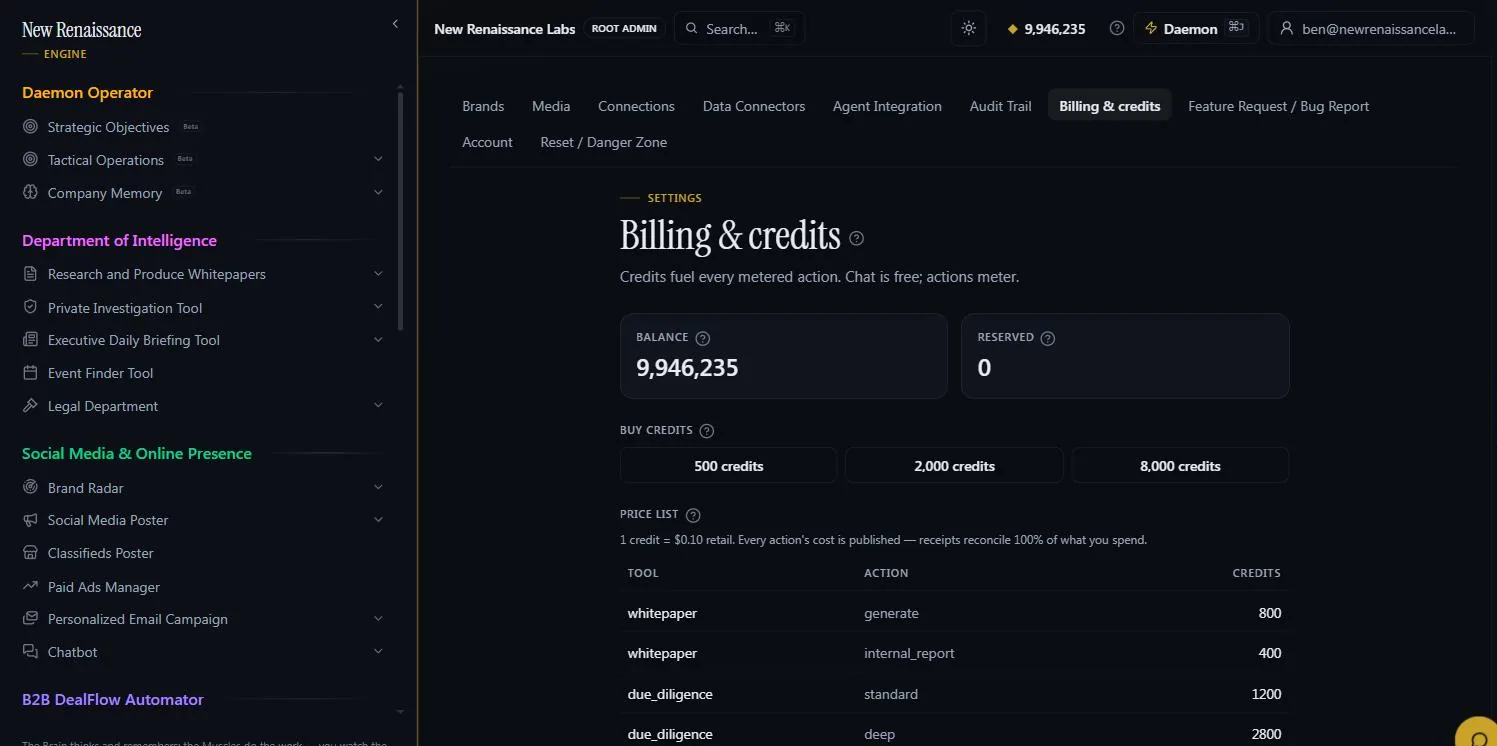
LiveAn append-only ledger of every credit movement; reserve, settle and release per job; the price shown before each run; an AI receipt in cents per model call; a billing panel with balance and reserved; and, for the firm, a monthly wholesale statement from the same rows.
02 — The Valuation Workbench
Computed by the engine, not by an AI.
The valuation engine is a pure function with no model in it. It takes the drivers, computes the methods in the ledger opposite, and writes an assumptions ledger that tags every driver as entered by the owner, prefilled from Company Memory, a default, or a posture preset. A model is allowed to do one thing: narrate the engine’s outputs in prose, after the engine has re-run from the saved drivers, and empty prose costs nothing.
Conservative, base and aggressive postures prefill and never lock. Presentation dials round the figures or set the narrative tone, which changes wording and never a number. The default currency is CAD, and the standing disclaimer on every output states that the figures reflect management’s assumptions and that the document is not investment advice.
| Method | What the engine computes |
|---|---|
| DCF | Per-year revenue, EBITDA, tax, capex, working capital and free cash flow; discount factors; present value of the explicit period and the terminal value; enterprise and equity value; the implied trailing multiple. |
| Discount rate | A build-up of risk-free rate, equity risk premium times beta, size premium and company-specific premium — or a WACC when debt is present. An explicit override is allowed and recorded. |
| Terminal value | Gordon growth, an exit multiple on EBITDA or revenue, or a weighted blend of both. A growth rate at or above the discount rate returns zero and a flagged gap, never an infinity. |
| Multiples | Revenue, EBITDA or seller's discretionary earnings times a multiple, with weights and comp notes. SDE is EBITDA plus the owner add-backs you apply. |
| Unit economics | Lifetime value, acquisition cost, their ratio, payback months, contribution margin and breakeven units — null when an input is missing, never guessed. |
| Round modeller | Pre- and post-money, the new investor's share, an option pool on a pre- or post- basis, SAFE conversion at the better of cap and discount, the founders' share after. |
| Sensitivity | A matrix of equity value across discount rate and terminal growth steps. |
| Football field | Low, mid and high per method with an automatic spread or manual bounds, and a weighted or equal-weight blend. |
| Assumptions ledger | Every driver with its provenance: entered by the owner, prefilled from memory, a default, or a posture preset. Presets fill and never lock. |
03 — A client engagement, end to end
Connect. Score and model. Open the room, close the month.
01
Connect and seed
Provision the client's workspace, then bring in the numbers: Shopify sync where the client sells on it, a CSV upload to the warehouse otherwise, and the financial intake fields in Capital Command. The Cash & Money Operations and Customers & Accounts floors of Company Memory fill from the internal reports and the connected data, with a provenance tier on every fact.
02
Score and model
Capital Command reads the five bars and lists the gaps in order, each with a link and a point value, so the engagement has a to-do list the client can see. The Workbench prices the company from its own drivers; the firm reviews the assumptions ledger, adjusts the posture, and keeps the provenance of every change.
03
Open the room, close the month
A Data Room is built from the client's fresh reports, reusing any that are still within the freshness window before spending a credit on a new one, and it reports who read which section and for how long. At month end the firm reconciles the client's credit ledger and AI receipts, and reads its own wholesale statement computed from the same rows.
A ledger an accountant can audit
Balances are never written; they are derived by a trigger from an append-only ledger with one row per movement. A reserve is matched by exactly one settle or release for its job; a cost above the reserve is absorbed by the platform and logged, never charged; failed runs are refunded in full. Every AI call leaves a receipt in cents, and a missing figure renders as a dash rather than a zero. The same rows produce the firm’s wholesale statement.
04 — Programme terms
Wholesale credits, one statement a month.
The firm pays its tier on every credit it grants, sets the plan price a client pays, and keeps the difference. A client on 1,500 credits a month can run 3 internal reports at 400 credits each, or hold the credits for the reports a data room needs.
| Term | As it runs today |
|---|---|
| Wholesale tiers | Tier 1 pays 50% of retail, Tier 2 45% and Tier 3 40%. Retail is 10¢ per credit; the tier is set on your partner row. |
| Starter credits per provision | Chosen per client at provisioning, defaulting to the plan's monthly allotment. Partner-initiated grants are capped at 100,000 credits per provision; every grant is an append-only ledger row. |
| Plan builder | Plans live on your partner record: a name, a monthly price, a monthly credit allotment and a tool list. You set the price your clients pay; the Engine's retail prices never appear in that conversation. |
| Statement cadence | Monthly. Credits granted in the month × 10¢ × your tier, computed from the ledger by the same function on the server and in the console. |
| Templates | generic-smb · ecommerce · local-service — each records the client workspace's tool set, task cadence and generation defaults at provisioning. |
RoadmapToday your staff’s hub chrome carries your brand name and colour; your clients run on the Engine’s chrome, and reports, drafts and mail carry the Engine’s theme. Client-facing domain theming, branded transactional email and PDFs, session-level impersonation, self-serve partner signup and client invitations are roadmap items we build on request.
No model computes a figure. A model may only narrate what the engine computed.
Related
Private equity firms
The same capital tools as the operating layer for every platform company, with the buy side included.
Related
Consultants
Run every client engagement on objectives, plans and the tactical floor, with the reports and the radar.
Related
The partner programme
How the programme works, the economics, and what is branded today.
Next step
Bring the harness to the businesses you already serve.
Tell us about your client base. We create the partner row, seat your staff, and provision a first client workspace with you.